
Signature service · Free
Get Your Roof Diagnosed, Not Sold
A documented inspection that checks seven roof systems, measures and photographs every visible defect, and ends in a written report you keep — with one plain result for the roof, and the honest recommendation even when that is to do nothing.
- 01One plain result for the roof: Good, Maintenance, Attention Needed, or Replacement Recommended
- 02Every visible defect measured in inches and counts, not adjectives
- 03Three date-stamped photos per defect, each pinned to a slope
- A plain repair-or-replace recommendation — replacement only when the math says so
- A probable-cause tag per finding: storm-created, or wear, age, or install
- Drone imagery of the slopes we can't safely walk
Request an assessment
Book it. Keep the report.
Every roofer in New Jersey offers a free estimate. An estimate is a price for work someone has already decided you need — it exists to sell a job, and the number at the bottom is the point. The Roof Health Assessment is a different document. It is a condition record: seven systems graded, every defect photographed and measured, and a written report that ends in a recommendation — which is sometimes that your roof is fine and you should spend the money elsewhere.
We built it because the trade runs on two dishonest moves. One is the storm-chaser who finds catastrophic damage on a roof with ten good years left. The other is the handyman who tars over a flashing failure on a roof that is quietly rotting from the deck up. Both start with the answer and work backward. An assessment starts with the roof: we measure what is there, write it down in inches and counts instead of adjectives, and let the evidence set the recommendation — including the recommendation to do nothing.
Six Things That Leave With You
Whether or not you ever hire us.
One plain result for the roof
Good, Maintenance, Attention Needed, or Replacement Recommended — one overall condition for the whole roof, stated on the first page. It is Zubar's own method, not an industry standard, and it is worked out against a written rubric off the ladder so the result is built to come out the same regardless of which of our inspectors climbs the roof. Because it is anchored to the same seven areas every time, next year's report is directly comparable to this one.
A written, itemized report
Every finding written down with its location on the roof, a measurement, and a probable-cause tag, emailed to you as a file rather than read aloud at the truck and forgotten. It leads with the overall condition, then rates each roof area on its own line, so a single urgent problem never gets buried inside a generally good roof.
A photo log for every defect
Three date-stamped photos of each defect: a locating shot for context, an overview, and a close-up with the problem in frame. Each one is pinned to a specific slope and elevation so anyone — an adjuster, a home inspector, the next crew — can find it again.
Drone imagery
We fly the slopes that can't be walked safely — steep pitches, brittle slate, three stories over landscaping — and pull that imagery into the report. Nothing gets graded 'probably fine' because a ladder couldn't reach it.
A repair-or-replace recommendation
A plain call, sorted by when it matters: Do Now, Plan, or Monitor. Keep up maintenance, repair the specific flagged items, or plan for replacement. When the honest answer is to do nothing yet, the report says exactly that and points to the next re-check date.
Every photo, yours to keep
You walk away with the full file — the written report and every photo — even if you never call us again. There is no deposit and nothing held against future work. If you file an insurance claim, the documentation is built to hand to your adjuster; if you sell the house, it is built to hand to a buyer's inspector.
What actually gets inspected
Seven systems, checked from the ground, on the roof, in the attic, and from the air. Flashing gets the most attention, because that is where water finds a joint before it finds a hole. Here is what the inspector is physically checking.
On the roof
- Step flashing at every wall junction — woven into the courses, not surface caulk
- Chimney counterflashing seated in a cut mortar reglet, not tar smeared over brick
- Kickout flashing at the bottom of each roof-to-wall intersection
- Valley construction type, centerline wear, and trapped debris
- Rubber pipe-boot collars for UV cracking, splitting, and pull-away at the base
- Granule loss, bald spots, curling, cupping, and clawing by slope
- Missing, wind-lifted, or creased tabs and ridge-cap condition
- Exposed or backed-out field fasteners and their corrosion
- Skylight curbs, head aprons, and side flashing
In the attic
- Sheathing underside for staining, frost, and condensation
- Rusted nail tips protruding through the deck — a moisture tell
- Ridge-line deflection and sag between rafters
- Daylight visible through the deck at the field or eaves
- Ridge and soffit vents for whether they are actually open
- Baffles keeping the eave intake path clear of insulation
- Mold growth and damp or matted insulation
- Prior sheathing patches and water staining on the rafters
At the perimeter
- Gutter slope and pitch toward the downspouts
- Gutter and fascia attachment, sag, and separation
- Overflow staining behind the fascia and on the siding
- Downspout discharge carried away from the foundation
- Aluminum drip edge at both eaves and rakes
- Ice-dam history and staining at the eaves
- Soft-metal collateral — gutter aprons, vent caps, downspouts — for wind or impact patterns
From the air
- Drone imagery of pitches too steep or brittle to walk
- Full-slope overviews on three-story elevations over landscaping
- Ridge-cap and hip runs photographed end to end
- Low-slope and porch membrane seams, blisters, and ponding
- A marked test square, with hit counts, where impact damage is in play
- Each defect located to a compass face or a numbered slope
- Chimney crown cracking, spalling, and open flue joints from above
The seven systems we work through
Zubar grades a roof as a system, against a written method covering seven areas. It is our own method. No board certifies it, no manufacturer publishes it, and it is not an industry standard. It exists so that any two Zubar inspectors walk the same roof and reach the same conclusions, and so the report you get a year from now is directly comparable to the one you are holding — the same areas, checked the same way, with the photographs to line up against each other.
Flashing & seals at walls, chimneys, and valleys
The metal that bridges the roof to everything it runs into — walls, chimneys, valleys, and the roof edges — which is where most roofs actually leak first.
- Step flashing woven into each course at every roof-to-wall junction, not surface-mount caulk
- Counterflashing seated in a cut mortar reglet at chimneys, not tar smeared over the brick
- Kickout flashing present at the bottom of every roof-wall intersection
- Headwall and sidewall flashing continuity above dormers and additions
- Valley construction type (open-metal, woven, or closed-cut), centerline wear, and trapped debris
- Aluminum drip edge at both eaves and rakes
- Cracked or lifting mastic at any flashing detail
When this system is the problem: The most common leak path on the roof is already open, and water is getting in at a joint rather than through the shingle field.
Pipe boots, vents, and skylights
Everything that punches up through the roof deck and has to be sealed around — plumbing vents, exhaust hoods, skylights, and the chimney crown.
- Rubber pipe-boot collars for UV cracking, splitting, and pull-away at the base
- Plumbing vent and exhaust hood collars for seating and corrosion
- Chimney crown for cracking, spalling, and open joints at the flue
- Skylight curbs, head aprons, and side flashing
- Solar, antenna, and satellite mounts for unsealed or oversized fastener holes
- Silicone or mastic 'repairs' hiding a failed component underneath
When this system is the problem: Small parts that wear out first are past their service life, and each one is a direct, hidden path for water into the ceiling below it.
Shingles & roof surface
The covering you see from the street, plus any low-slope membrane on a porch or addition roof, judged for wear and weatherproofing.
- Granule loss and bald spots exposing the asphalt mat
- Curling, cupping, and clawing across each slope, worst on south and west exposures
- Blistering, cracking, and thermal splitting
- Missing, wind-lifted, or creased tabs and ridge-cap condition
- Exposed or backed-out field fasteners and their corrosion
- Low-slope membrane seams, blisters, and EPDM shrinkage at terminations where present
When this system is the problem: The surface is losing the granule and mat layer that makes it waterproof, so the field is wearing out even where nothing has leaked yet.
Attic ventilation & moisture
Whether the attic breathes — balanced intake and exhaust — and what the underside of the roof shows about trapped moisture.
- Ridge or other exhaust vent type and whether it is actually open
- Soffit intake vent count and whether insulation or paint has blocked it
- Baffles keeping the intake path clear at the eaves
- Attic staining, frost, or condensation on the sheathing underside
- Rusted nail tips protruding through the deck (a moisture tell)
- Mold growth and damp or matted insulation
When this system is the problem: Trapped heat and damp are cooking the shingles from below and feeding mold, which shortens the life of every layer above the attic.
Wood decking & structure (provisional)
The plywood or plank under the shingles and the framing holding it up, graded only from what the attic and roof surface reveal — the full picture appears when the covering comes off.
- Attic-visible sheathing rot, delamination, and soft spots
- Ridge-line deflection and sag between rafters
- Daylight visible through the deck at the field or eaves
- Water staining and prior sheathing patches on rafters and decking
- Undersized or stapled original decking where visible
- Gross structural movement at ridges, hips, and valleys
When this system is the problem: The wood that holds fasteners and carries load is compromised, and this number can drop once the roof is stripped, because rot under an intact covering does not show until tear-off.
Gutters & drainage
Where the water goes once it leaves the roof — gutters, downspouts, valleys, and any spot where water sits instead of running off.
- Gutter slope and pitch toward the downspouts
- Gutter and fascia attachment, sag, and separation
- Overflow staining behind the fascia and on the siding
- Downspout discharge carried away from the foundation
- Valley flow and debris damming
- Ponding on low-slope sections that never fully drains
- Ice-dam history and staining at the eaves
When this system is the problem: Water is backing up, overflowing behind the fascia, or pooling, which puts the roof edges, the fascia, and the foundation at risk.
Age vs. observed remaining life
How far into its rated lifespan the roof is, anchored to the wear we can measure rather than an install date we are often only told.
- Observed wear stage measured against the shingle line's rated lifespan
- Remaining granule reserve across the field
- Mat flexibility versus brittleness at the tab edges
- Documented install date or permit record where one exists
- Prior repair history and how many separate spots have been patched
- Whether a matching shingle is still stocked for future repairs
When this system is the problem: The roof is near or past the years its shingles were built for, so failures will start clustering and accelerating from here.
How the results work
Three plain layers, and no numbers to decode. The whole roof gets one overall condition. Each roof area that was actually inspected gets its own status, because a slate front and an asphalt rear are two different roofs with two different lifespans. And every recommendation is timed, so you know what has to happen now and what can wait.
The whole roof gets one result
- Good
- No active defects, and wear that is normal for the roof's age. Keep up routine maintenance and re-assess once a year.
- Maintenance
- A few targeted issues are showing, but the roof has years of service left in it. Handle the specific repairs the report flags and stay on an annual inspection.
- Attention Needed
- Real problems are letting water in now or are about to, though most are still repairable. Repair the flagged defects before interior damage follows, then re-assess after the work.
- Replacement Recommended
- Defects are spread widely enough that repairs stop paying for themselves. Plan for replacement, with a free written itemized estimate to compare against continued patching.
Each roof area is rated on its own
- Good
- This area is doing its job and needs nothing beyond routine upkeep.
- Repair
- This area has a defined defect that can be fixed without replacing it.
- Replace
- This area is past the point where repairing it is the sensible money.
Every recommendation is timed
- Do Now
- Water is getting in, or will before the next season. Handle it first.
- Plan
- Needed, but it can be scheduled and budgeted rather than rushed.
- Monitor
- Nothing to do today. Re-check it at the next assessment.
The areas are the ones your roof actually has — we don't force every property into the same list of headings.
An estimate sells a job. An assessment records a condition.
From the driveway the two look identical — a person climbs your roof, comes down, and talks. The difference is what they were looking for. An estimator is pricing a scope that was chosen before the ladder went up; the faster they reach a number, the sooner they can close. Nothing in a free estimate is built to survive you saying no.
The assessment inverts that. The deliverable is not a price — it is the documented condition of your roof, worked out against a written method rather than a salesman's gut, with each roof area rated on its own evidence. If the report comes back Good and says the roof needs nothing, that is a successful assessment: you paid nothing and you learned the truth. And because Zubar is a roofing contractor and not a public adjuster, the report never pretends to settle an insurance claim, and getting it never requires signing an Assignment of Benefits.
| A free estimate | A Roof Health Assessment |
|---|---|
| A price for a scope someone already chose for you. | A graded condition record; the scope, if any, follows from what's found. |
| A number produced on the spot to close the sale today. | A result worked out off the ladder against a fixed written method. |
| Findings described in selling words: 'significant damage.' | Findings measured: a 14-inch crease, 6 backed-out nails. |
| A few phone photos at most, with no location or measurement. | Each defect located to a slope and elevation, with its own photos. |
How the result turns into a repair-or-replace call
The overall result does most of the work. Good and Maintenance mean the roof has years left and the report just flags specific items to handle; replacement is not on the table. Attention Needed means water is getting in now or about to, but most of it is still repairable, so the move is to fix the flagged items and re-assess afterwards. Replacement Recommended means defects are spread across enough of the roof that repairs stop paying for themselves, and the honest math points to replacement.
Underneath that, each area carries its own status, because a roof is only as dry as its worst detail. One missing chimney counterflashing lets water in tomorrow no matter how good the rest of the roof is. Rating the areas separately is what stops that from going either way badly: the urgent defect is marked Repair and timed Do Now so it cannot be missed, and the roof is not pushed toward replacement on the strength of one bad joint. An otherwise-excellent roof with one dead flashing is a one-repair job, not a replacement case we are willing to manufacture.
None of this decides itself in a vacuum. The recommendation weighs age, repair history, and how many separate spots have already been patched. Three repairs at different spots in eighteen months on a twenty-year roof is the roof telling you it is done; one flashing failure on a ten-year roof is a Tuesday. When repair is the right answer we say so, and when a roof replacement is the smarter money we put that in writing too, with a free itemized estimate to weigh against continued patching.
One bad detail does not condemn a roof
A roof is only as dry as its worst detail. A missing chimney counterflashing lets water in tomorrow no matter how good the rest of the roof is, so a single overall verdict can hide the exact thing that is flooding your attic — or, handled badly, let one bad detail condemn a roof that is otherwise fine. The report is built so neither happens. The area with the defect is marked Repair or Replace on its own line, and the work is tagged Do Now, so an urgent problem is impossible to miss without dragging the whole roof down with it.
This is a deliberate guard against manufacturing a replacement. A roof that is sound everywhere but has one dead counterflashing is a one-repair roof, and that is exactly how it reads: Attention Needed overall, one area marked Repair and timed Do Now, everything else Good. Fix that one thing and the next assessment says so. Every finding like this also gets its own photo set and, where it applies, an interior corroboration such as an attic stain, daylight through the deck, or a moisture-meter reading.
Buying, or just bought, a house you don't know the roof on
A home inspector gives the whole house a few hours, and the roof gets a line or two of it — often from the ground. That is enough to say a roof looks old. It is not enough to tell you what the roof needs, what it will cost, or how long you have. An assessment is the second read: a roofer's inspection of the roof alone, documented, with no work attached to it.
- You're under contract and the inspection report's roof note was vague
- You closed recently and inherited a roof with no history, no paperwork, and no idea of its age
- The roof is more than one material or has been added to, and you can't tell which parts are original
- You want an independent condition baseline before you decide between repairing and replacing
- A contractor has already quoted you a replacement and you want the condition documented first
Ridgewood, Bergen County
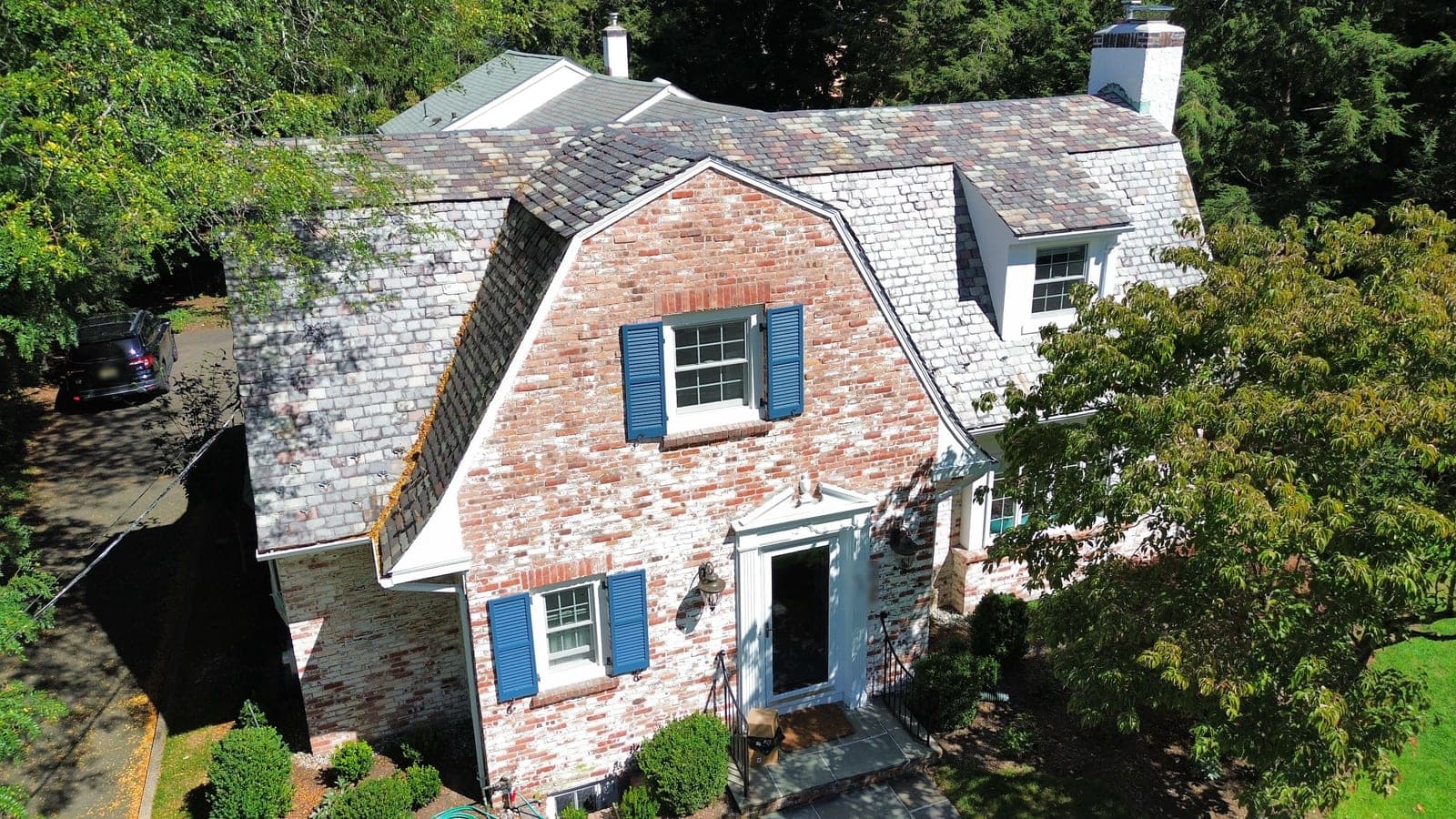
A recent homebuyer in Ridgewood asked us to look at a roof that was two roofs: historic slate across the front, asphalt across the rear. The question was the one buyers usually have — is this a repair or is this a replacement, and how urgent is it?
The assessment separated them. The front slate was serviceable and rated for targeted repair, with the ridge needing a slate-compatible detail rather than wholesale replacement. The rear asphalt roof was rated for replacement, with decking conditions, chimney flashing and ventilation to be addressed during that work. Overall condition: Attention Needed. The replacement was timed Do Now; the slate repairs were timed Plan; the rest was Monitor.
That is the distinction a single overall verdict would have destroyed. Called one way, the whole roof gets condemned and the slate comes off a house that did not need it. Called the other, the rear keeps leaking because the front looks fine from the street.
What the report actually looks like
This is a real Roof Health Report from the Ridgewood assessment above, not a mock-up. The homeowner's name, street address and report ID were redacted before the image was made.
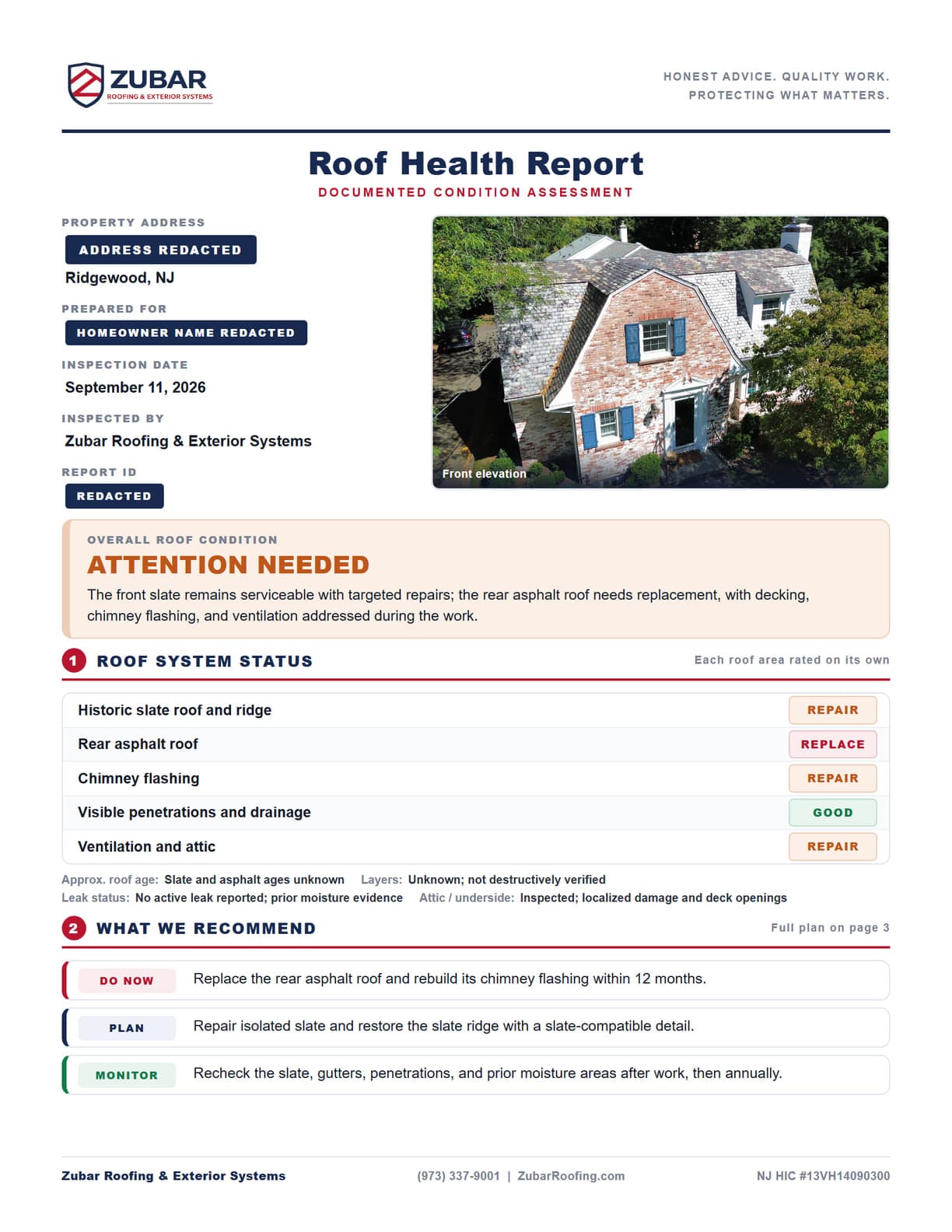
The report, and how to read it
The report comes to you as a file. It leads with one overall condition for the roof, then rates each roof area that was actually inspected on its own line — Good, Repair, or Replace — so a single urgent problem never hides inside a generally good roof. A roof whose only real defect is a dead counterflashing reads exactly as what it is: Attention Needed overall, one area marked Repair, everything else Good.
The areas are the ones your roof actually has. A house with a slate front and an asphalt rear gets those rated separately, because they are separate roofs with separate lives — we do not force every property into the same list of headings. Each finding also carries a probable-cause tag — storm-created, or wear, age, or installation — because that distinction is yours and your carrier's to weigh. And any concealed item we couldn't see — underlayment, ice-barrier coverage at the eaves, the nailing pattern — is marked as inferred from the home's code era and visible wear, never presented as if we measured it.
- One overall condition for the roof, with each inspected area rated Good, Repair, or Replace
- Every finding located to a slope and elevation
- A measurement per finding — inches, counts, or square feet, not adjectives
- Three date-stamped photos of each defect
- Drone imagery of the slopes we couldn't safely walk
- A probable-cause tag per finding: storm-created, or wear, age, or installation
- A note on which concealed items were inferred rather than inspected
- The repair-or-replace recommendation, sorted into Do Now, Plan, and Monitor
What we record so the report holds up
A conclusion is only as good as the photo log under it. Every finding in the report is documented so that an adjuster, a home inspector, or the next Zubar crew can stand where our inspector stood and check the same thing. We record measurements, not adjectives — a crease is 14 inches, not 'significant.' Drone imagery covers the slopes we cannot safely walk, and each defect is located to a specific slope and elevation.
Some things cannot be seen without taking the roof apart, and we never rate them as if we measured them. Underlayment type, ice-barrier coverage at the eaves, and the concealed nailing pattern are recorded as inferred from the home's code era and the wear we can see. We also tag the probable cause of each finding — storm-created versus wear, age, or installation — because that distinction is the homeowner's and the carrier's to weigh, and collapsing the two together would misrepresent both.
- Three date-stamped photos per defect: a locating shot for context, an overview, and a close-up with the defect in frame
- The specific slope and elevation of each finding (front or rear, compass face, or a numbered slope diagram)
- A measurement recorded in inches, counts, or square feet rather than a descriptive word
- Hit or damage counts inside a marked and photographed test square where impact damage is in play
- Collateral evidence on soft metals — gutter aprons, vent caps, downspouts — that corroborates directional wind or impact patterns
- A probable-cause tag on each finding: storm-created, or wear, age, or installation
- A note on which concealed items are inferred rather than inspected, so nothing reads as measured that wasn't
From Phone Call to Written Report
Five steps. No sales appointment disguised as an inspection.
- 1
Book it
Call or text (973) 337-9001, or use the contact form. Non-emergency assessments book roughly 3-5 business days out. An active leak in a storm gets routed for a same-day tarp first in most of our service area, and the assessment follows once the water is stopped.
- 2
The on-site inspection
An inspector works the roof, the attic, and the perimeter, then flies the slopes that can't be walked. Plan on a couple of hours on site, depending on the size and complexity of the roof. You don't need to be home, though attic access helps a great deal.
- 3
Documentation
Every finding gets its photos, its measurement, its location, and a probable-cause tag on the spot. Concealed items — underlayment, ice-barrier coverage at the eaves, the hidden nailing pattern — are recorded as inferred from the home's code era and visible wear, never graded as if we measured them.
- 4
The written report
Back at the office the seven systems are worked through against the written method, each roof area is rated on its own evidence, and the report is assembled with the overall condition, the per-area statuses, the photos, and the recommendation sorted into Do Now, Plan and Monitor. That work happens off the ladder on purpose, so it is deliberate rather than rushed. The report goes to your inbox once it is done — we don't put a stopwatch on it.
- 5
Your decision, on your timeline
You read the report and decide. If it comes back Good, you're done. If it flags repairs, you can hire us, hire anyone, or sit on it and re-check next year — nothing about the assessment obligates you to a repair.
When an assessment is the right call
- You have a stain on a ceiling and no idea where the water is entering
- Your roof is past 15 and you want to know how much life is actually left
- A storm came through and you need the damage documented before you file
- A door-knocker told you that you need a new roof and you want a second read
- You're buying a house and the home inspector's one-line roof note was vague
- You're selling and want a documented condition record to hand a buyer
- You've paid for three repairs in two years and want to know if you're patching a corpse
- Nothing is visibly wrong and you want a yearly baseline to watch the roof hold
Where we stop
A condition record, not a coverage decision
The Roof Health Report documents the condition of your roof. It does not decide what your insurance company owes you. Those are two different jobs done by two different parties: a contractor documents condition, and only your carrier's adjuster determines coverage. You cannot hand an adjuster our report and expect it to settle a claim — they run their own inspection against your policy, and they should. What we hand you is the documented evidence, which is the part that actually survives scrutiny.
Zubar is a roofing contractor, not a public adjuster and not an attorney. In New Jersey, negotiating or adjusting a claim on a homeowner's behalf for a fee requires a public adjuster license, which we do not hold and do not pretend to. Our role is to inspect, photograph and measure the damage, write a scope of the repair, and meet your adjuster on the roof to walk the damage and answer technical questions. We do not 'handle your claim,' file it for you, or fight your insurer. We never take an Assignment of Benefits, and we never waive or absorb your deductible — doing so is insurance fraud in New Jersey. You keep every photo we take, whether or not you hire us.
Frequently Asked Questions
Book the Assessment. Keep the Report.
Free, on-site, across Bergen, Passaic, Essex, Hudson, Morris counties. If your roof is sound, we'll tell you that and leave.