Skylight leaks are one of the most misdiagnosed problems on the roof. Water shows up on the drywall around the frame, everyone assumes the flashing failed, and a caulk gun comes out. Often the flashing is fine and the water was never coming from the roof at all.
We start every skylight call the same way — by finding where the water is actually coming from before anyone quotes a repair. Sometimes that is a flashing kit or a rotted curb. Sometimes it is the air in your bathroom. The two problems have nothing in common except the wet spot they leave, and fixing the wrong one costs you money and leaves you still leaking.
First, rule out condensation
The single most useful thing we can tell you about skylights: a large share of the leaks we get called for are not leaks. They are condensation. In January, warm humid air inside the house rises and meets the coldest surface in the room, which is almost always the glass and the aluminum frame of the skylight. The water vapor in that air turns back to liquid on that cold surface, runs down the frame, and drips onto the drywall in exactly the way a roof leak would. The water came out of the air in your room, not through the roof.
The pattern gives it away. Condensation follows the weather and the humidity in the house, not the rain.
The fix for that is ventilation and lower indoor humidity — running the bath or kitchen exhaust fan during and after the moisture, balancing attic intake and exhaust so the roof deck and the skylight shaft stay closer to outdoor temperature, and in some homes adding insulation to the shaft walls. A roofer who tarps or re-caulks a condensation problem has fixed nothing and will be back. This is where our skylights and ventilation work usually solves the actual problem.
- It appears only in cold weather, and only after a shower, a bath, cooking, or a full house of people
- The water is clear, with no brown staining or grit carried in it
- It stops when indoor humidity drops or when the exhaust fan runs
- There is no matching wet path in the attic or down the skylight shaft above the ceiling
- Older single-pane or aluminum-framed units over a bathroom or kitchen are the usual offenders
The flashing kit is where real leaks start
When it is a genuine leak, the flashing is the first suspect. A skylight is not sealed with a bead of caulk. A correctly installed unit is flashed with the manufacturer's kit built for that exact model: a head flashing across the top, a sill or apron piece at the bottom, and step pieces that lace up both sides course by course — all laid over an ice-and-water membrane that wraps up the curb before the flashing goes on. The membrane is the real waterproofing; the metal sheds the bulk of the water off it.
The kit has to match two things, and this is where installs go wrong. It has to match the skylight model, because flashing cut for a curb-mount unit will not seal a deck-mount, and it has to match the roof covering, because a kit made for asphalt shingles sits at the wrong height and step spacing for tile, slate, or standing-seam metal. A universal reach for silicone at the joints is the tell that the right kit was never used.
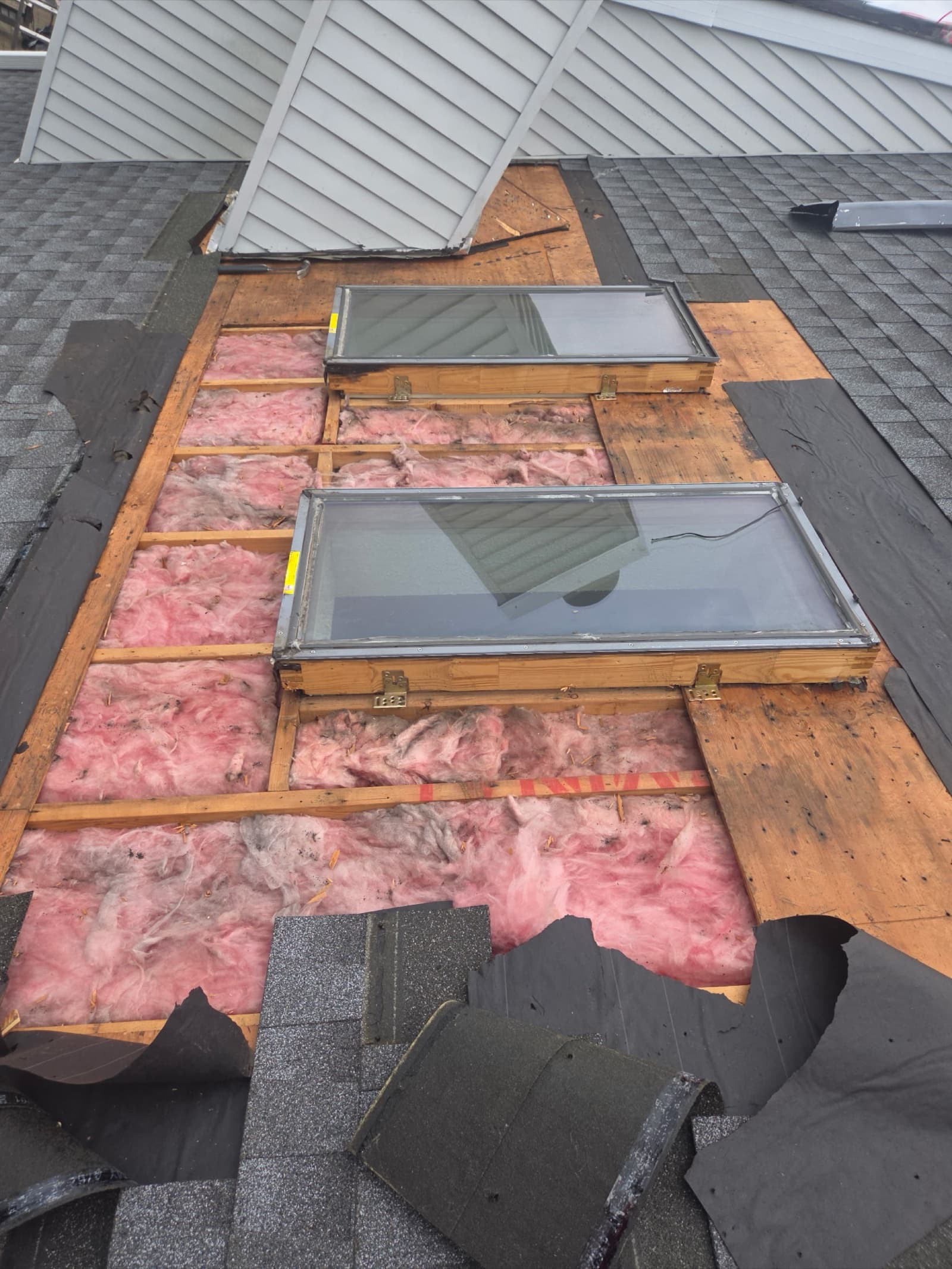
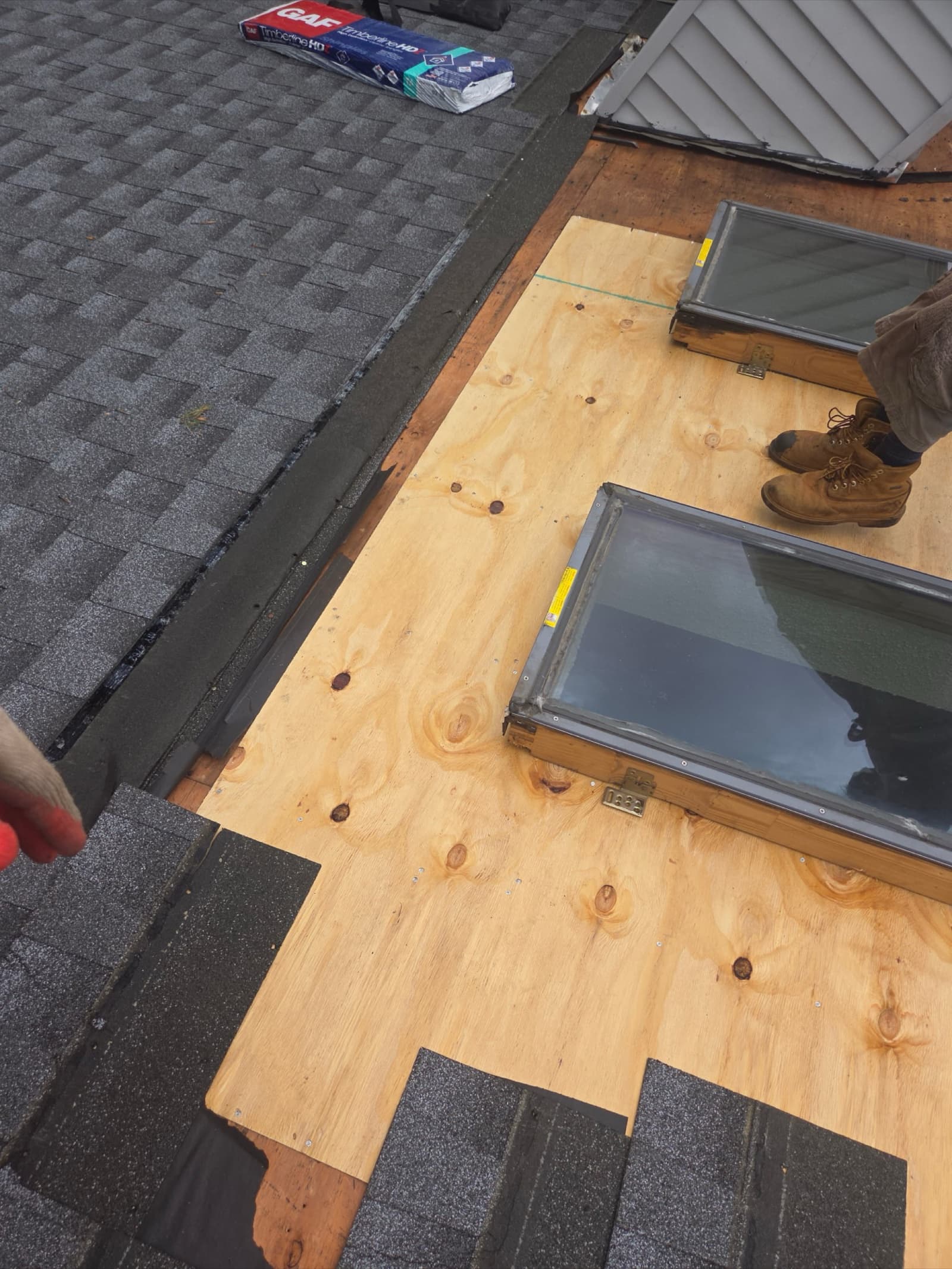
One failure shows up again and again on New Jersey homes: skylights leaking about a year after a roof replacement. When a roof is torn off, the honest move is to pull the skylight and install a fresh flashing kit as the new shingles go on. Cheaper crews leave the old flashing bedded in place and shingle up to it. Reused step pieces are bent, fatigued, and no longer sitting in fresh membrane, so they hold for a season and then open up — which is why so many skylight roof leak calls trace straight back to the last re-roof.
The curb, the gaskets, and the weep channels
Under the flashing is the curb — the raised frame the skylight sits on, built up from the roof deck or integral to a curb-mount unit. Once water has been getting past the flashing for a while, the curb is often already soft or rotting, and no reseal holds on wet wood. If we find rot, rebuilding or replacing the curb comes before any new flashing, or the repair fails from underneath.
The seals themselves wear on a clock of their own. The EPDM and rubber gaskets around the sash and the glazing seals harden, shrink, and crack under years of direct UV, and a hairline gap in a sun-baked gasket is enough to let wind-driven rain past. These are the parts that put an otherwise sound skylight into the Pipe boots, vents, and skylights area of a Roof Health Assessment as an active defect.
The last suspect surprises most homeowners. Modern skylights are designed to admit a little condensation and wind-driven water on purpose and drain it back out through weep channels molded into the frame. When those channels pack with pollen, roof grit, and pine needles, the water they were built to carry away backs up over the lip and spills inside — a unit that is working exactly as designed except for a clogged drain. Clearing the channels is sometimes the entire repair.
- Curb: checked for rot, soft spots, and separation from the deck before anything is resealed
- Sash and glazing gaskets: inspected for UV hardening, shrinkage, and hairline cracks
- Weep channels: cleared of debris so the frame's built-in drainage actually drains
- Fasteners and cladding: checked for backed-out screws and open holes at the frame
Fogged glass is a seal failure, not a roof leak
If the glass itself is cloudy or fogged between the two panes, the moisture is inside the sealed insulated glazing unit and nothing on the roof is leaking. The thermal seal around the edge of the glass has failed, and the sealed space between the panes — often filled with argon for insulation — is now breathing humid air that condenses into a haze when it cools. It looks alarming from below, but no flashing repair touches it because the problem is the glass unit, not the roof.
This is a failed component, and the fix is replacement rather than sealant. On many units the glazing pane can be swapped by itself without replacing the whole skylight; on older or fixed-frame units, the whole skylight is the more sensible replacement.
A fogged unit is also worse than a cosmetic problem, because a failed seal means the insulating gas is gone and the glass now runs colder than it should. Colder glass sweats more, which feeds the condensation problem from the first section — so a skylight that fogged and a skylight that drips in January are often the same aging unit telling you two things at once.
Deck-mount, curb-mount, and the pitch problem
Skylights install two ways. A curb-mount unit sits on a built-up wood curb that raises it above the plane of the roof. A deck-mount unit fastens flat to the deck with an integral flashing flange, sitting lower and looking sleeker. Both are fine when they are matched to the roof, and both leak when they are not.
Every skylight is rated for a minimum roof pitch, and this is where a lot of deck-mount installs fail. Drop a deck-mount unit onto a roof flatter than its rated pitch and water does not shed off the head flashing fast enough — it lingers, works sideways under the flange, and leaks no matter how carefully the kit was installed. On a low slope the right answer is a curb-mount unit lifted up on a tall curb so water clears the top edge, or, on a genuinely flat section, no skylight at that spot at all.
When we inspect a leaking skylight, the mounting type and the roof pitch tell us early whether we are looking at a repair or a design that was never going to stay dry. We would rather tell you the unit is on too flat a roof for its type than sell you a reflash that buys a year.
Repair now, or replace with your next roof
When the flashing, a gasket, a clogged drain, or a soft curb is the whole story and the skylight itself is sound, repair is the right call and usually a single visit. There is no reason to replace a working unit because one component wore out, and we will not push you toward one.
The replace call turns on seal life. A skylight's gaskets and glazing seal age like anything else exposed to the weather, and once they are hardened and near the end, chasing leaks with more sealant is spending money on a part that is retiring. The sensible moment to replace an end-of-life unit is during your next roof, because the flashing has to come off and go back on anyway. That labor overlap means you pay for the flashing work once instead of twice, and the new unit gets a fresh kit set into new membrane with the new shingles — which is exactly how a skylight avoids the one-year re-roof leak in the first place. If a replacement is on the horizon, we fold it into the roof replacement estimate so you see the real number.
Either way, the skylight is one of the seven areas we grade in a Roof Health Assessment, and the written report tells you whether yours is a clear-the-drain repair, a reflash, or a unit to plan around when the roof goes on.
When You Actually Need This
- Clear water runs down the skylight only in cold weather after showers or cooking
- A brown stain has spread on the drywall or shaft around the skylight
- The glass has fogged or clouded between its two panes
- A skylight started leaking about a year after a roof replacement
- Water drips from the skylight during wind-driven rain but not a calm rain