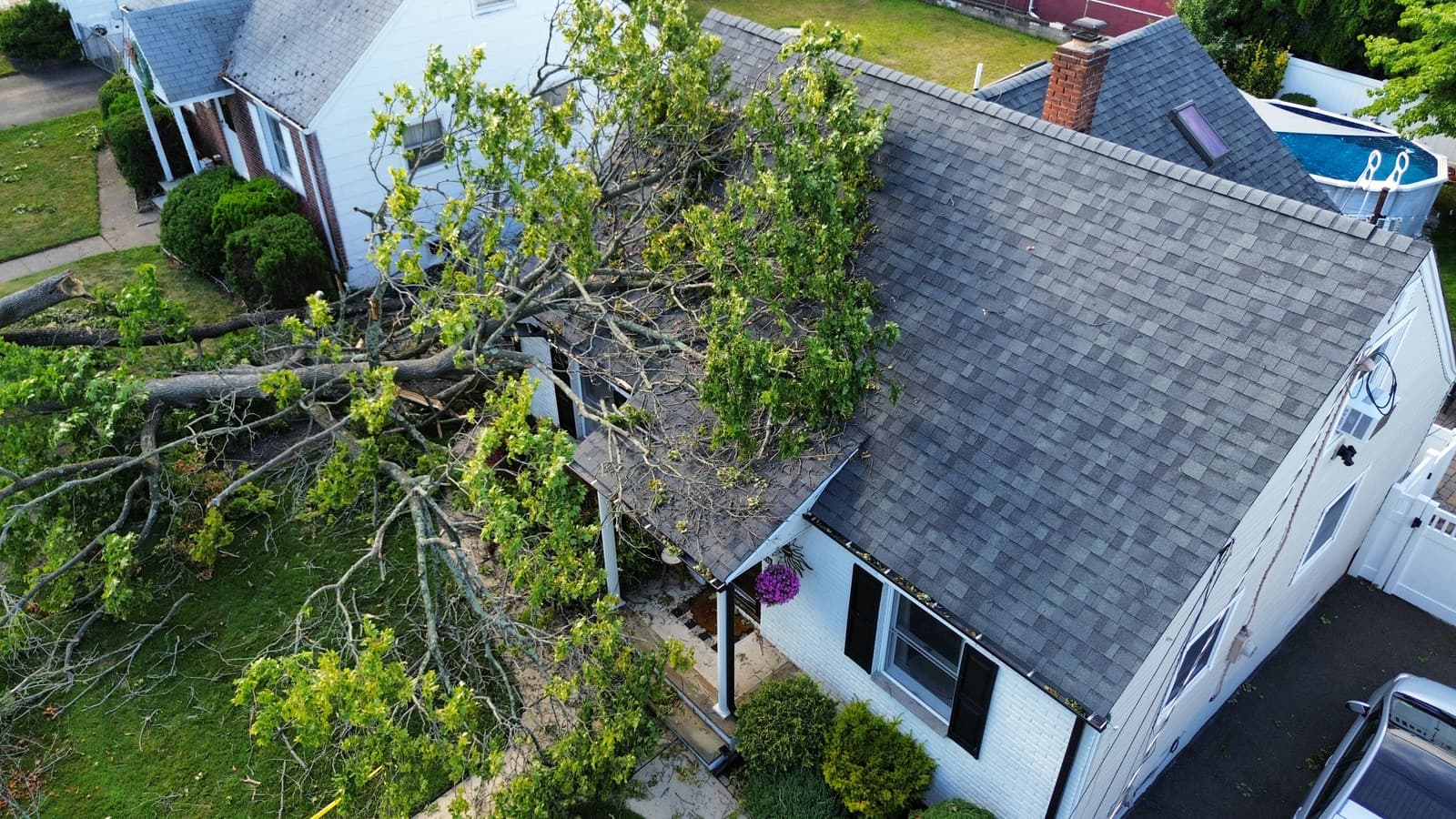
A tree coming down on a house is one of the few roofing calls that starts as a safety problem and only later becomes a roofing problem. Before anyone thinks about shingles, the order of operations is get people out from under the rooms the tree hit, handle any electrical hazard, and only then call a roofer. We get tree-strike calls across Bergen, Passaic, Essex, Hudson, and Morris counties, and the ones that go badly almost always go badly in the first hour — someone climbs up to eyeball it, or drops a tarp over a rafter a limb already cracked, and turns a repairable roof into a collapsed one.
Zubar treats every tree strike as a structural question first. A limb heavy enough to break shingles is heavy enough to crack a rafter, split a truss at the heel, or shove framing off the wall it was bearing on — and none of that has to show from the ground. We come out, read the framing from the attic and the roof, stabilize what's safe to stabilize, document everything before it gets cleaned up, and rebuild from the deck up. If the strike needs an engineer before a roofer, we tell you that instead of shingling over a broken frame.
The first ten minutes: people, power, then the phone
The sequence matters more than the speed. First, get everyone out of the rooms directly under where the tree hit and keep them out. A ceiling holding water and broken plaster can come down without warning, and a cracked rafter can let go hours after the impact, not at the moment of it.
Then deal with electricity, because water and power together is the part of a tree strike that actually kills people. Water tracking down a ceiling toward a light fixture or a junction box is an electrocution and fire hazard, so if the ceiling near any fixture is wet — or if the strike bent or pulled the service mast, the metal pipe that carries the wires from the roof down to your meter — cut power at the main breaker before anyone goes near the wet area. A pulled mast is also the utility's responsibility to reconnect, not a roofer's, so it belongs in the same early call.
If there are downed power lines anywhere on the property — in the yard, across the driveway, tangled in the fallen tree — call 911 and your utility, stay back at least the length of the span, and never approach a line or the tree touching it. A live line can energize the wet ground and the tree around it. Only after people are clear and the electrical hazards are handled does emergency roof repair belong in the sequence.
- Clear the rooms under the impact and keep everyone out
- Cut power at the main panel if ceilings are wet near fixtures or the service mast was pulled
- Call 911 for any downed line — never approach it or the tree touching it
- Photograph the scene before anything is moved
- Call a roofer to stabilize and assess, not to climb up and eyeball it
Why a tree strike is structural until proven otherwise
The dangerous thing about impact damage is how little it shows. A limb can drop, split a rafter along its length, and rebound off — leaving a roof surface that looks nearly untouched from the curb while the frame under it is carrying load through a broken member. Trusses are worse. An engineered truss is designed as one rigid triangle, so cutting or cracking any single chord or web takes the whole truss out of design. A truss can be knocked off the top of the bearing wall it sits on, or split at the heel where the bottom chord meets the top chord, and still look like it's in place.
A compromised rafter or truss must not be loaded by a person or a tarp until it has been evaluated. This is the exact mistake that turns a claim into a catastrophe: a homeowner or a rushed crew climbs onto the damaged slope to throw a tarp, and the added weight finishes what the tree started. We read the framing first — from inside the attic, where the breaks actually show — and stabilize from the edges and from sound framing, never by loading the damaged span.
In the attic we look for fresh splits with clean, light-colored wood, deflection in a ridge or rafter line that wasn't there before, daylight where there shouldn't be any, and any truss plate that's been pulled or any framing shifted off its bearing. Fresh breaks read differently than old ones, which matters both for safety and for the cause tag that goes on the insurance side — a break that happened in the storm generally reads as a covered loss, while one that's been there for years generally does not.
Three kinds of impact, three different repairs
Impact damage isn't one thing, and the repair scales with the force behind it. We sort tree damage into three levels, and the level drives everything — whether this is a same-week roofing repair or a framing job that needs an engineer before a shingle goes back on.
- Glancing branch strike — a branch scrapes or pokes the surface, puncturing shingles and sometimes cracking a sheet of decking. The damage is localized and usually a straightforward repair: replace the broken decking, rebuild the underlayment and flashing in the area, and reshingle to match. The framing is typically untouched.
- Limb drop — a heavier limb falls more or less straight down and lands as a concentrated point load. This is the one that cracks rafters and punches through decking in a defined area. The roofing repair is real, but the framing question comes first: the cracked or split rafters get sistered or replaced before the deck and roof surface go back.
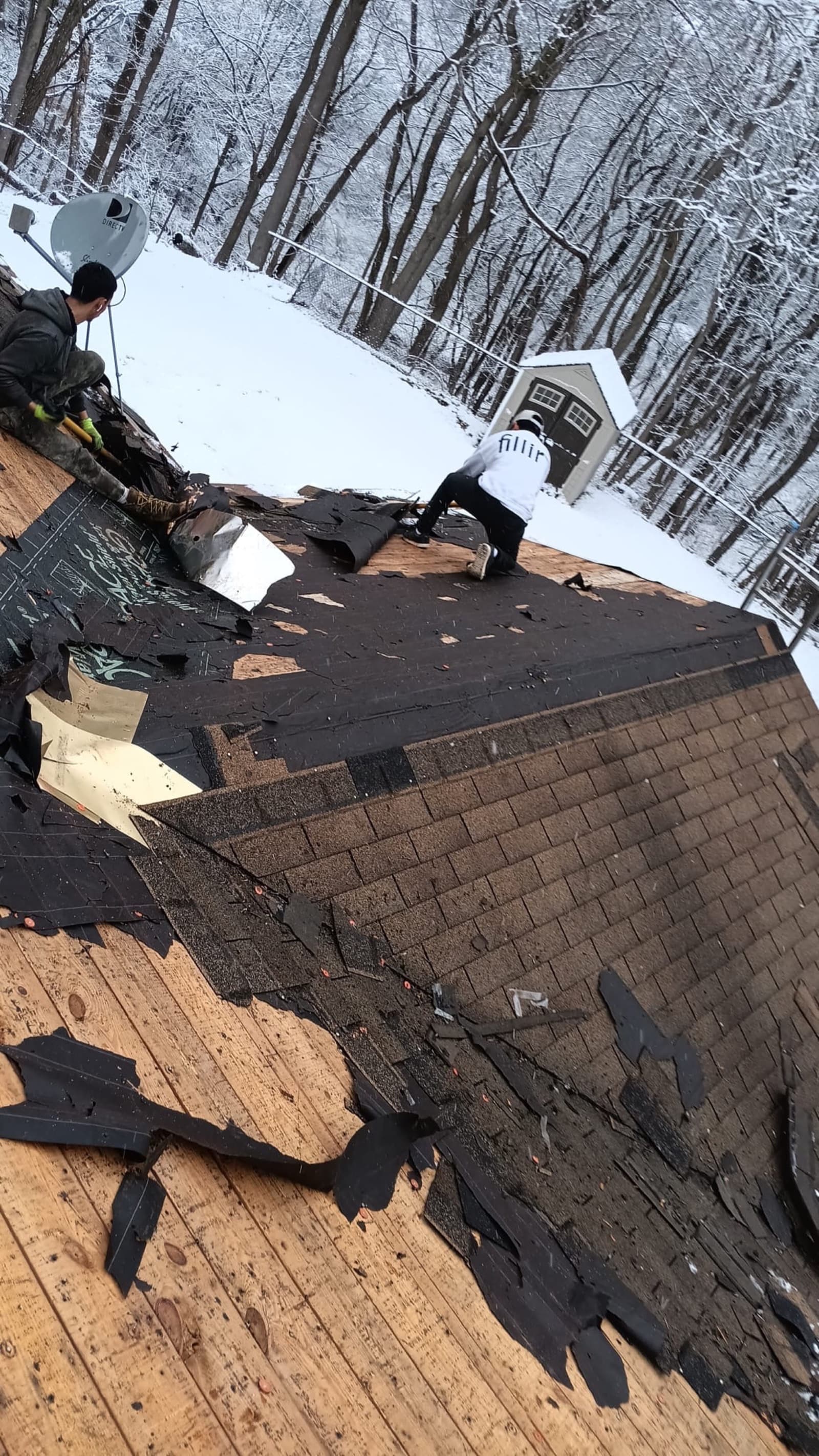
- Full trunk strike — a whole trunk or a major leader comes down across the roof. This is a structural event, not a roofing one. It commonly requires a licensed engineer to assess the framing and specify the repair, framing rebuilt to that spec, and only then the deck, underlayment, flashing, and shingles. Anyone who quotes you a shingle repair on a trunk strike without addressing the frame is selling you a cover-up.
Two trades, sometimes two coverages
Getting the tree off the roof and rebuilding the roof are two separate jobs done by two separate trades. A tree service — with cranes, riggers, and the insurance to lift tonnage off a structure — removes the tree. A roofer rebuilds what the tree damaged. Having one do the other's work is how people get hurt and how roofs get finished wrong. We coordinate the sequence with your tree service so the removal doesn't do more damage on the way off, and so the roof gets stabilized the moment the weight is clear.
On the insurance side, removal and repair can fall under different parts of the same homeowners policy, and who pays for what depends on where the tree came from and what it hit. Whether the removal itself is covered — and up to what limit — often turns on whether the tree struck a covered structure versus simply falling in the yard. Repair of the roof it landed on is a separate line. These are policy-specific questions with real limits attached, so check your policy or ask your carrier directly rather than assuming the whole event is one covered number.
Our role in the claim is the same as on any storm loss: we inspect, photograph and measure the damage, write a scope of the repair in the language adjusters use, and meet your adjuster on the roof to walk it. We don't file the claim for you, we don't take an Assignment of Benefits, and we never waive your deductible — that's fraud in New Jersey. For the full picture of how we document damage and meet the adjuster on a storm loss, see insurance restoration.
When it's the neighbor's tree
The most common question after a neighbor's tree comes down on your house is: shouldn't they pay for this? In general terms — and this is a legal question, not a roofing one — liability usually turns on negligence and prior notice. That means whether the tree was visibly dead or dangerous, and whether the owner had been put on notice about it before it fell. A healthy tree that comes down in a storm is generally treated as an act of nature, and each owner's carrier tends to cover their own damage.
Regardless of whose tree it was, your own homeowners carrier is typically the first call. You file with your insurer, they cover your damage under your policy, and if there's a case that the neighbor was negligent, the carriers sort out subrogation between themselves — your insurer pursues the neighbor's insurer to recover what it paid, and if that succeeds, your deductible can come back to you. That process happens above your head. Your job in the meantime is to document, file, and repair, not to wait on a liability argument while your ceiling stays open to the weather.
We stay in our lane here. We're roofers, not attorneys, and we won't guess at how New Jersey liability law lands on your specific situation — for that, talk to your carrier and, if the amounts warrant it, a lawyer. What we will do is hand you a documented scope of the damage that holds up no matter which carrier ends up paying for it.
What to photograph before anything moves
The single most valuable thing you can do in the first hour costs nothing: photograph everything before anyone moves the tree or starts cleanup. Once the tree service lifts the trunk off, the scene that proves what happened is gone, and you're reconstructing it from memory for an adjuster who wasn't there. Shoot wide for context, then closer on each point of damage, from the ground and from inside the affected rooms — never from the damaged roof itself.
If a specific member failed — a cracked rafter, a punched-through sheet of decking, a split ridge board — and it's going to be replaced, keep the failed piece if you can do so safely, or at least get clear photos of the break before it's hauled off. Note the date and time of the storm too. Carriers tie coverage to a specific date of loss, and a tree that came down in last week's wind is a different claim than one that's been leaning on the house since spring.
Once the scene is documented, we can put a properly battened tarp over the opening to stop the water — anchored to sound framing and strapped with 1×3s, not stapled to broken shingles that tear loose in the next gust. See emergency roof tarping for how we stabilize an open roof before the permanent repair, and the Roof Health Assessment for how we grade decking and structure, which stays provisional until the covering comes off and the framing is fully exposed.
- Wide establishing shots of the tree on the house from several angles
- Close-ups of each impact point and every hole in the roof surface
- Interior photos of wet ceilings, stains, and any fallen plaster
- The date and time of the storm that brought the tree down
- The failed framing member itself, kept or photographed before disposal
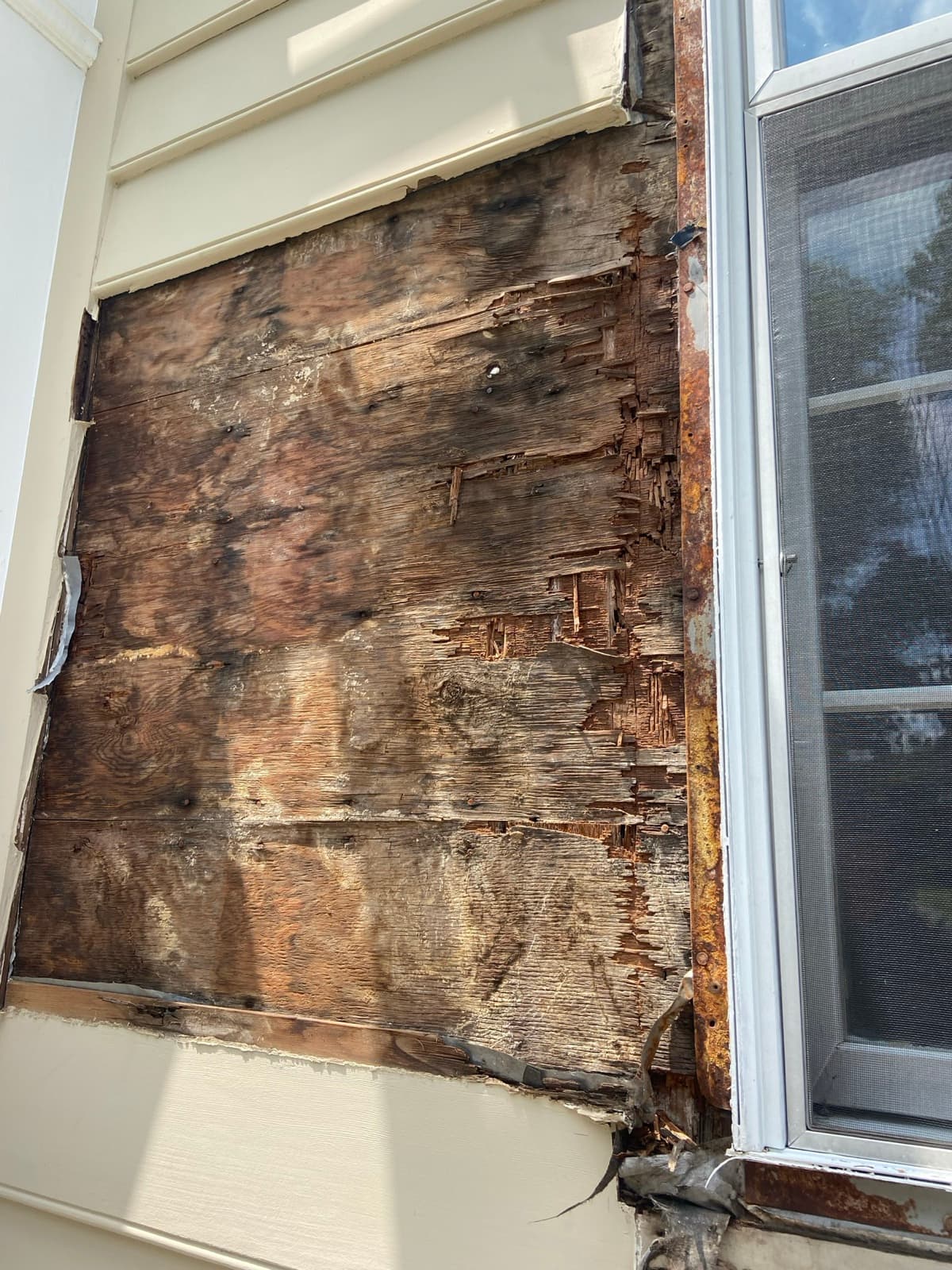
- Anything the tree also hit on the way down — gutters, siding, windows, the service mast
When You Actually Need This
- A limb or whole tree is resting on or through your roof
- A branch punched a hole and rain is coming into a room
- A storm passed and you now see cracked or sagging ceiling lines
- A neighbor's tree came down onto your house
- The strike bent or pulled the electrical service mast at the roof