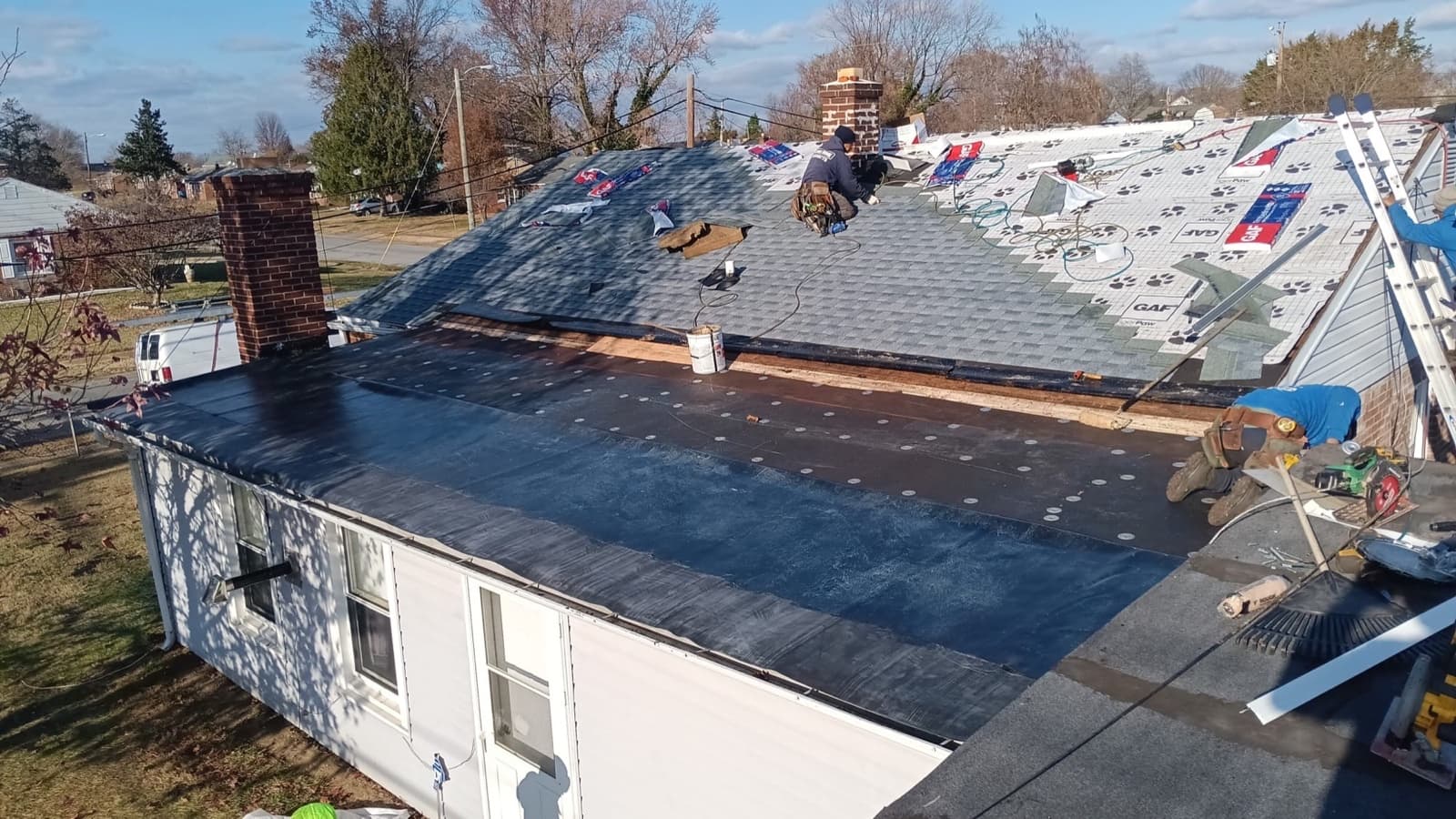
Hudson County is the densest county in New Jersey, and a fundamentally different roofing environment from the suburbs: brownstones, brick row houses, and multi-family buildings with flat and low-slope roofs dominate, from Jersey City through North Bergen, Union City, and Kearny. Membrane roofing — welded TPO, EPDM rubber, and modified bitumen — is the core of the work, and the details are everything.
Housing across Hudson County
Attached brownstones and brick row houses, multi-family and mixed-use buildings, and waterfront mid-rise condos — overwhelmingly flat or low-slope. Parapet walls, shared walls, and tight access between attached buildings define the work.
What we most commonly find on Hudson County roofs
- Failed flat-roof seams on brownstones and row houses
- End-of-life built-up tar-and-gravel roofs
- Parapet wall and coping flashing failures
- Ponding water on under-sloped roofs
- Leak diagnosis between attached and shared-wall units
In Hudson County, the First Question Is Who Controls the Roof
Hudson is the only county in our footprint where most people asking about a roof cannot simply decide to replace it. About 85 percent of the county's housing units sit in multi-unit structures, roughly a third of them in buildings of twenty units or more, and only around 31 percent of occupied units are owner-occupied. Single-family detached housing is about nine percent of the stock — against 65 percent in Morris.
So before material or price, the useful question is what you own and what you control: a whole building, a unit in a condominium where the roof is common element and the association decides, or a two- or three-family where the decision is shared. We will say plainly which of those we think applies and who needs to authorise the work, because a roof quote given to someone who cannot commission the job wastes their time and ours.
Flat-Roof Country, and Pre-War at That
Close to 30 percent of Hudson County's housing predates 1940, and that pre-war stock is overwhelmingly attached and flat-roofed: brownstones, brick row houses, two- and three-family buildings, and mixed-use blocks, with waterfront mid-rise added on top of it. The roofing that follows is membrane work — welded-seam TPO, EPDM rubber, modified bitumen — not shingle work with a flat section attached.
The failure points are specific to the building type. Parapet walls and their copings are where most of these roofs actually leak; internal drains and scuppers decide whether water leaves at all; and on attached buildings the party-wall edge and the neighbour's roof height determine how the termination has to be detailed. Access is its own constraint, because there is frequently no way to get material to the roof except through the building or over a neighbour's. We plan that at the survey rather than on the morning of the job.
Hudson County towns we serve
We service roofs in Jersey City, Bayonne, Kearny, North Bergen, Secaucus, Union City, and West New York — plus the surrounding Hudson County communities. Several have their own page below.
Why we work in Hudson County
Hudson County roofs are flat-roof work, and flat roofs are won on welded seams and proper flashing — the membrane work we specialize in. Jersey City is a straight shot down Route 1&9 from Clifton.
Familiar landmarks
Liberty State Park · Hudson River waterfront · Journal Square · Secaucus Meadowlands