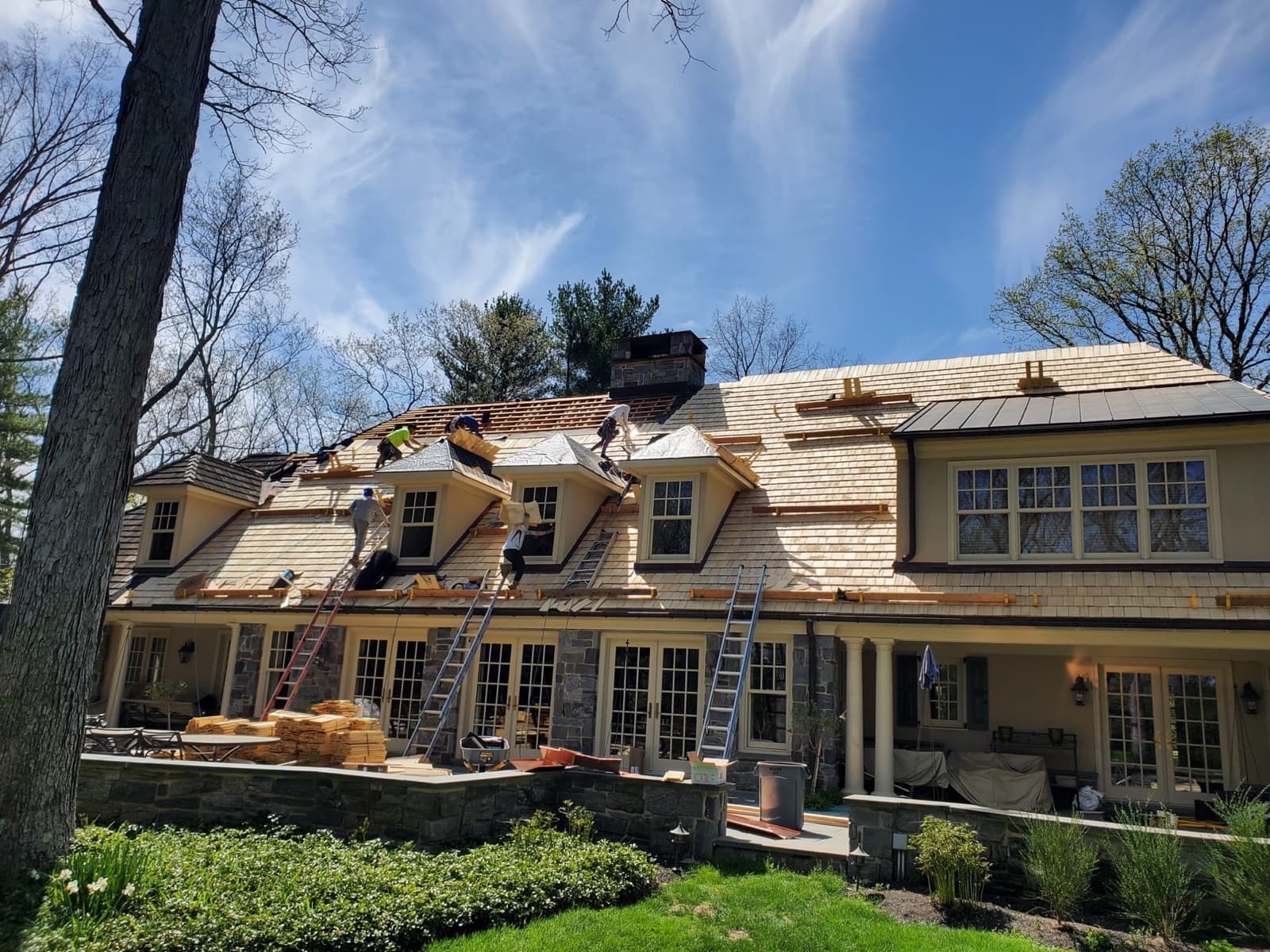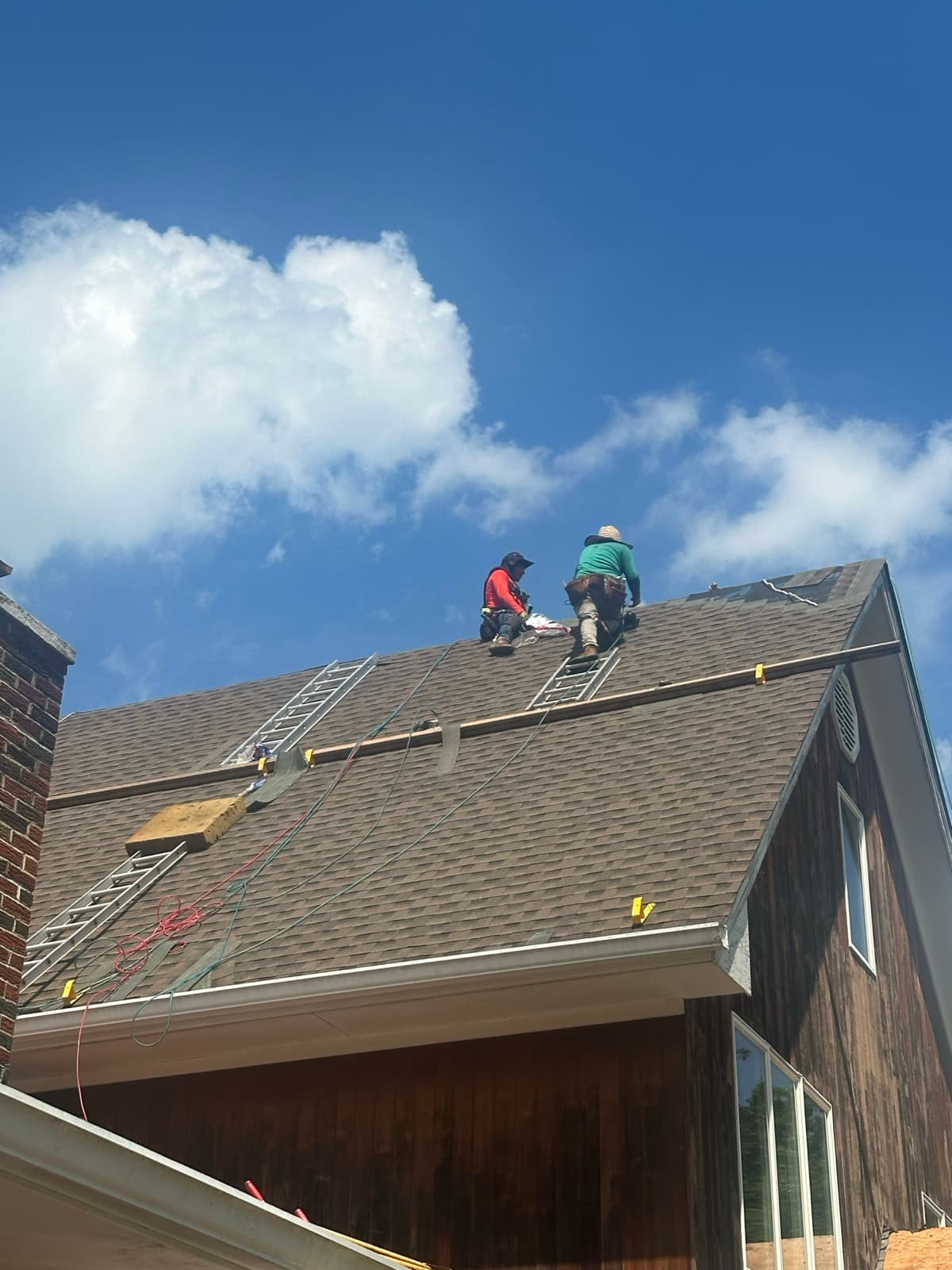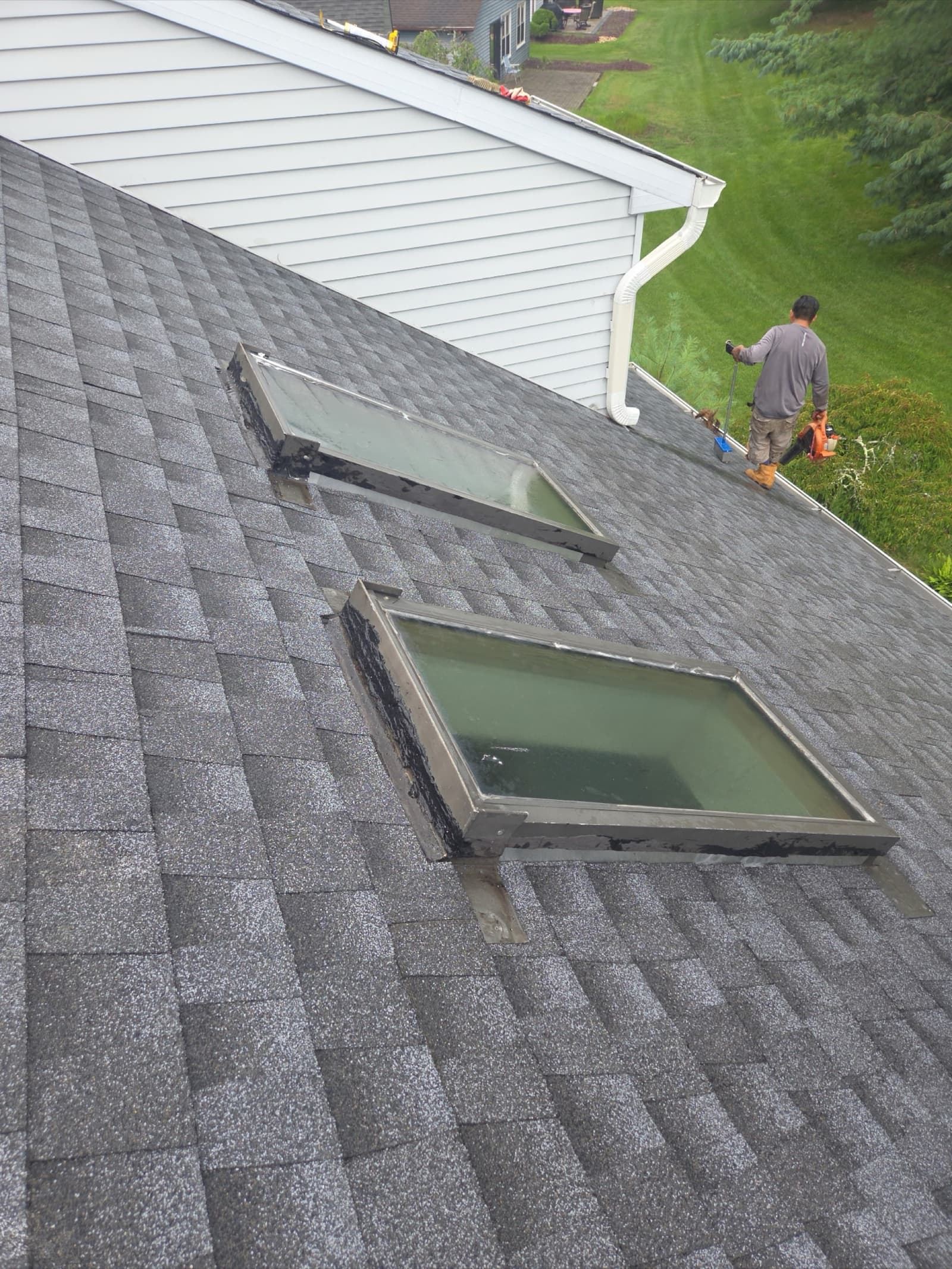
Glen Rock is a 2.7-square-mile borough of about 12,300 people between Ridgewood and Fair Lawn, and it is older than its suburban reputation suggests. Four of its houses are individually listed on the National and New Jersey Registers of Historic Places — eighteenth and nineteenth century Dutch sandstone farmhouses, all listed in 1983 under the Stone Houses of Bergen County thematic resource. A borough with that heritage would normally come with a historic commission attached. Glen Rock does not have one, and that combination shapes what is actually useful to say here: identify what is on your roof properly, and know that the decision about what goes back on it is entirely yours. We inspect, photograph what we find, and put the scope and price in writing before anything is scheduled.
Housing in Glen Rock
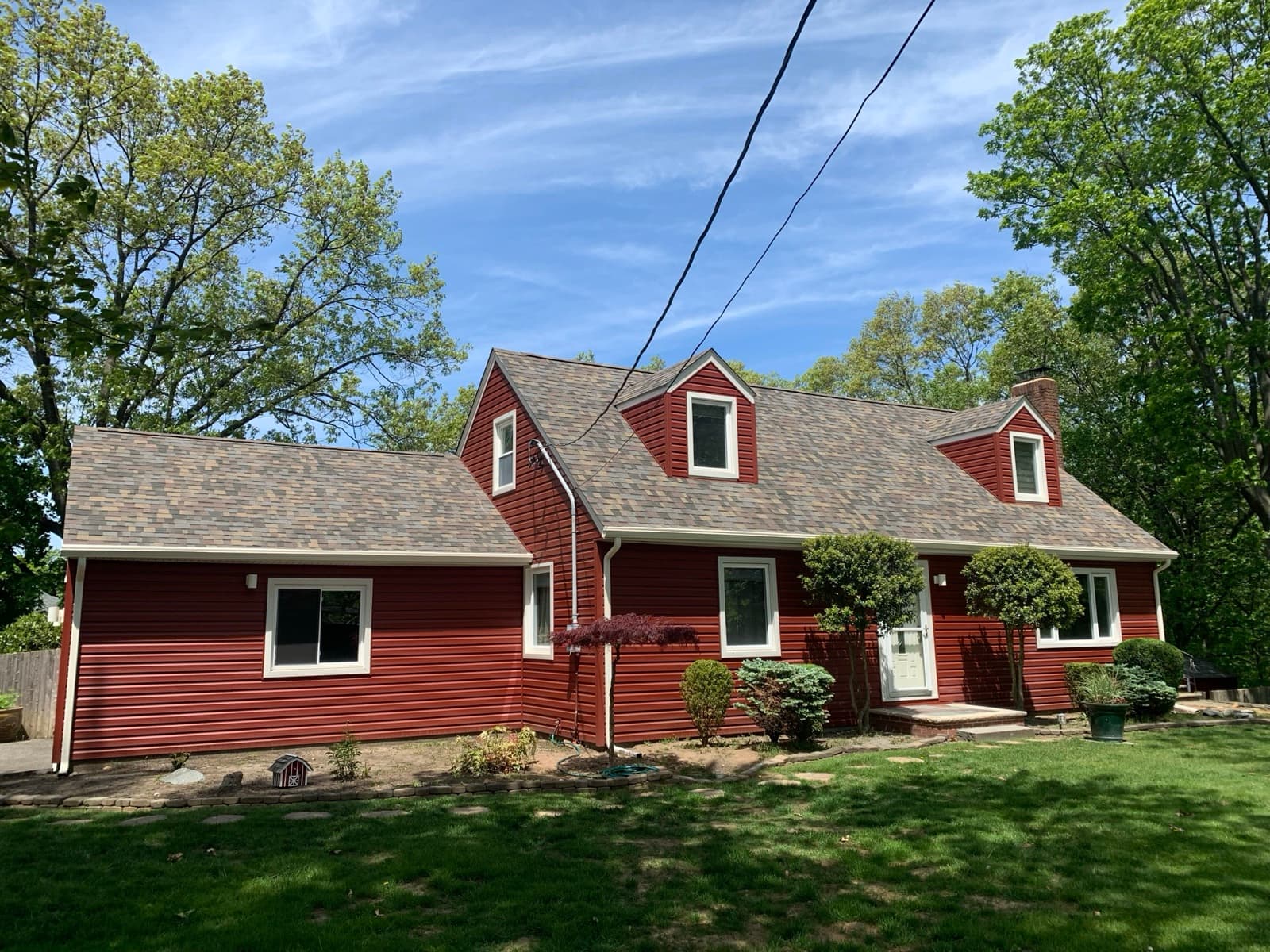
Roughly 2,685 owner-occupied single-unit homes in Glen Rock were built before 1980, give or take a few hundred either way, and the borough's stock runs considerably older than that in places — a substantial share predates 1940. Worth stating plainly, because it is where a lot of roofing sales talk goes wrong: the year a house was built is not the age of its roof. A borough this old has houses on their third or fourth covering and houses that were redone last decade, and the construction date distinguishes neither. What the age profile does predict is variety. Glen Rock rooflines include steep older gables and gambrels with sweeping overhangs alongside ordinary post-war slopes, and the first job on any older roof here is establishing what material is actually up there and what has been done to it before.
What we most commonly find on Glen Rock roofs
- Roofs whose covering has been misidentified — slate, slate-look composite and heavy architectural asphalt are routinely confused, and the repair for each is different
- The gambrel break, where the pitch changes sharply partway down the slope and water arrives fast at the oldest detail on the roof
- Flared eave overhangs on older houses, which throw water clear of the wall but concentrate ice at the eave in winter
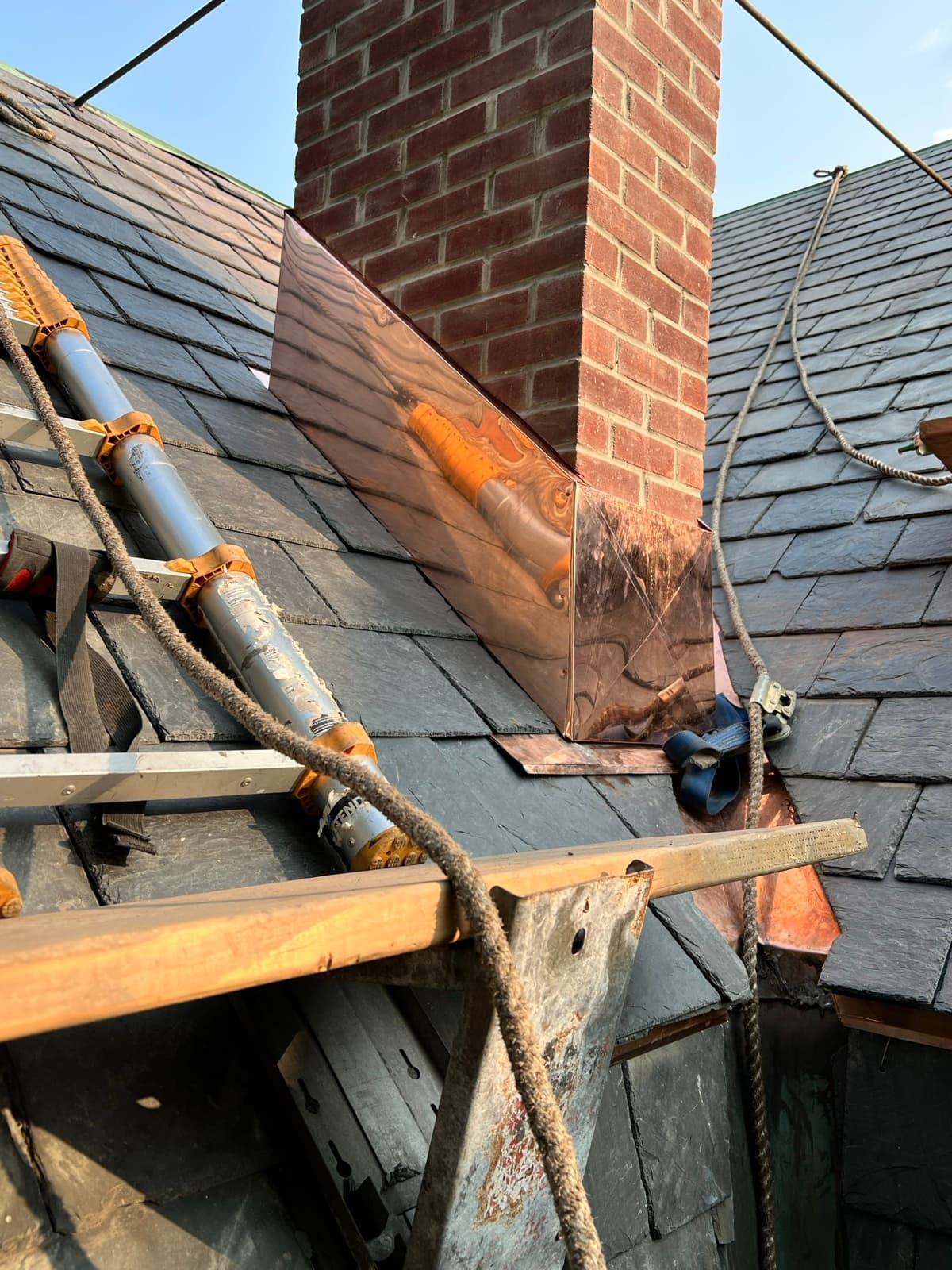
- Counterflashing into stone and rubble chimneys, which cannot be cut and sealed the same way as flashing into brick or clapboard
- Valleys on cut-up older rooflines that carry concentrated water and are often the first component to fail
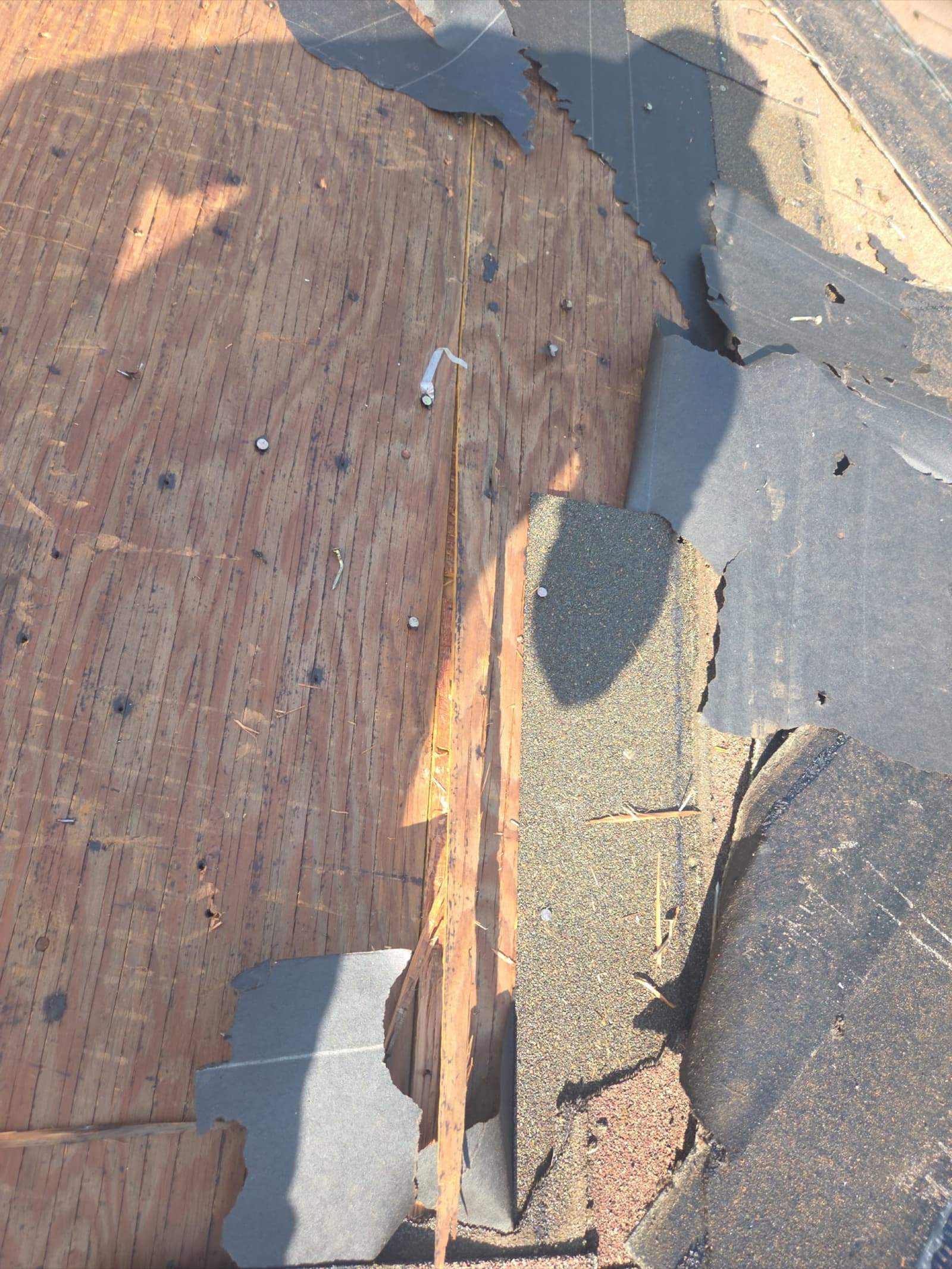
- Previous repairs where a junction needing formed metal was sealed with mastic instead, which holds briefly and then leaks worse
Find out what is actually on your roof before anyone quotes a tear-off
This is the single most useful thing we can tell a Glen Rock homeowner, and it costs nothing. Before you accept a price for a full replacement, establish what the existing covering is — because on an older borough roof the answer changes both the diagnosis and the money by a wide margin.
Natural slate is stone. It is heavy, it rings rather than thuds when tapped, the pieces are individually uniform in thickness, and the edges chip rather than crack. A slate roof that has lost a dozen slates has usually not failed. Very often the slate field is sound and what has actually failed is the metalwork — the valley linings, the flashings and the nails holding it all on — which is a far smaller job than a replacement. Slate-look composite and heavy designer asphalt imitate the appearance convincingly from the ground and behave nothing like it. A designer shingle roof genuinely at the end of its life does need replacing; a sound slate field does not, and stripping one is an expensive mistake that cannot be undone.
The other thing worth identifying is the roof form, because form predicts where the failure is. A gambrel — the barn-shaped profile with a break partway down each slope — puts a sharp pitch change in the middle of the run. Water arrives at that break travelling quickly, the detail there is often the oldest thing on the roof, and it is a classic leak point. A flared eave overhang, common on the older houses here, sheds water away from the wall but slows it at the eave, which is exactly where ice forms in a hard winter. On a straightforward post-war gable, none of this applies and the field of shingles is the story.
We identify covering and form at the inspection, photograph both, and say in writing which one you have. If the honest answer is that your roof has years left and needs a valley rebuilt, that is what the estimate will say.
Glen Rock has no historic district and no design review — and that is unusual
Homeowners near the older parts of the borough often assume they need someone's approval before changing a roof. In Glen Rock they do not, and the position is unusually clear-cut.
The Borough Code creates no historic preservation commission, no historic district and no design or architectural review body. Its land use chapter establishes exactly two boards, the Planning Board and the Zoning Board of Adjustment, and its zoning chapter contains no historic district and no historic overlay. The borough's own list of boards and committees names no preservation or design review body either. There is nothing in Glen Rock's ordinances that subjects the appearance of a roof to municipal review.
One distinction is worth drawing carefully, because the opposite claim circulates. Four Glen Rock houses are individually listed on the National and New Jersey Registers — the Ackerman-Hopper House on Ackerman Avenue, the Hendrick Hopper House on Ackerman Avenue, and the Andrew H. and Garret Hopper Houses on Prospect Street. Register listing is a real designation and those are genuinely historic buildings. But listing on a register is not the same thing as local designation, and it does not by itself restrict what an owner does to a private house. There is also no Prospect Street historic district in Glen Rock. A 1983 county historic sites survey suggested that such a district might be created and grouped with an adjacent part of Ridgewood; it was a suggestion in a survey, no ordinance ever enacted it, and a municipal historic district cannot cross a municipal boundary in any case.
So: if you want to change from slate to a slate-look designer shingle, change colour, or change profile, nothing in the borough process stands in the way. The constraint is your own judgement about the house — which is worth exercising on a stone farmhouse, even when nobody is making you.
The permit answer, and a claim you will see that is wrong
Glen Rock publishes no roofing permit rule of its own. Its construction chapter simply sets up the borough's Uniform Construction Code enforcing agency, and its fee schedule contains no roofing line at all. So the applicable law is the statewide one.
Under N.J.A.C. 5:23-2.7(c), the listed items are ordinary maintenance and shall be treated as such by every enforcing agency, with no permit, inspection or notice required — and the list includes the repair or replacement of existing roof covering on detached one- and two-family dwellings. Two limits ride along with that, as everywhere in New Jersey: the exemption covers the covering, so replacing sheathing or decking or doing anything structural needs a permit; and it is written for detached dwellings, so attached homes, townhouses and condominiums are treated differently.
We will flag one thing because it is actively misleading. Several roofing contractors' own marketing pages state that Glen Rock requires a permit for a full roof replacement. That is not a municipal source and it does not match the state regulation for a detached one- or two-family house. A municipality cannot require a permit for work the State classifies as ordinary maintenance. If a roofer tells you the borough requires a permit for your detached-home reroof, ask them to show you where the borough says so.
Where a permit genuinely is required, Glen Rock's Building Department is at Borough Hall, 1 Harding Plaza, and forms can be dropped in the box outside or mailed. Inspection requests go through the borough's online portal and, as the borough itself emphasises, state rules require them in writing at least 24 hours ahead. One practical note that catches people out: the borough repealed its own Construction Board of Appeals in 1997, so a code appeal here goes to the Bergen County Construction Board of Appeals rather than to a local board.
Why we work in Glen Rock
Glen Rock sits between Ridgewood and Fair Lawn, both of which we already cover, and it would be easy to treat it as more of the same. It is not. It is an older borough with genuinely varied roof materials and forms, four Register-listed stone houses, and a regulatory position — no historic district, no design review, no local permit rule — that almost nobody states correctly, including several contractors who assert the opposite in print. Getting the identification right and the rules right is most of the value on offer here, and both are things we can do before anyone signs anything. We have no completed Glen Rock project to point to and we will not imply one.
Glen Rock sections we cover
Glen Rock estimates cover the whole municipality — the Prospect Park section, Ferndale, and the Rock Road business district — across ZIP code (07452).