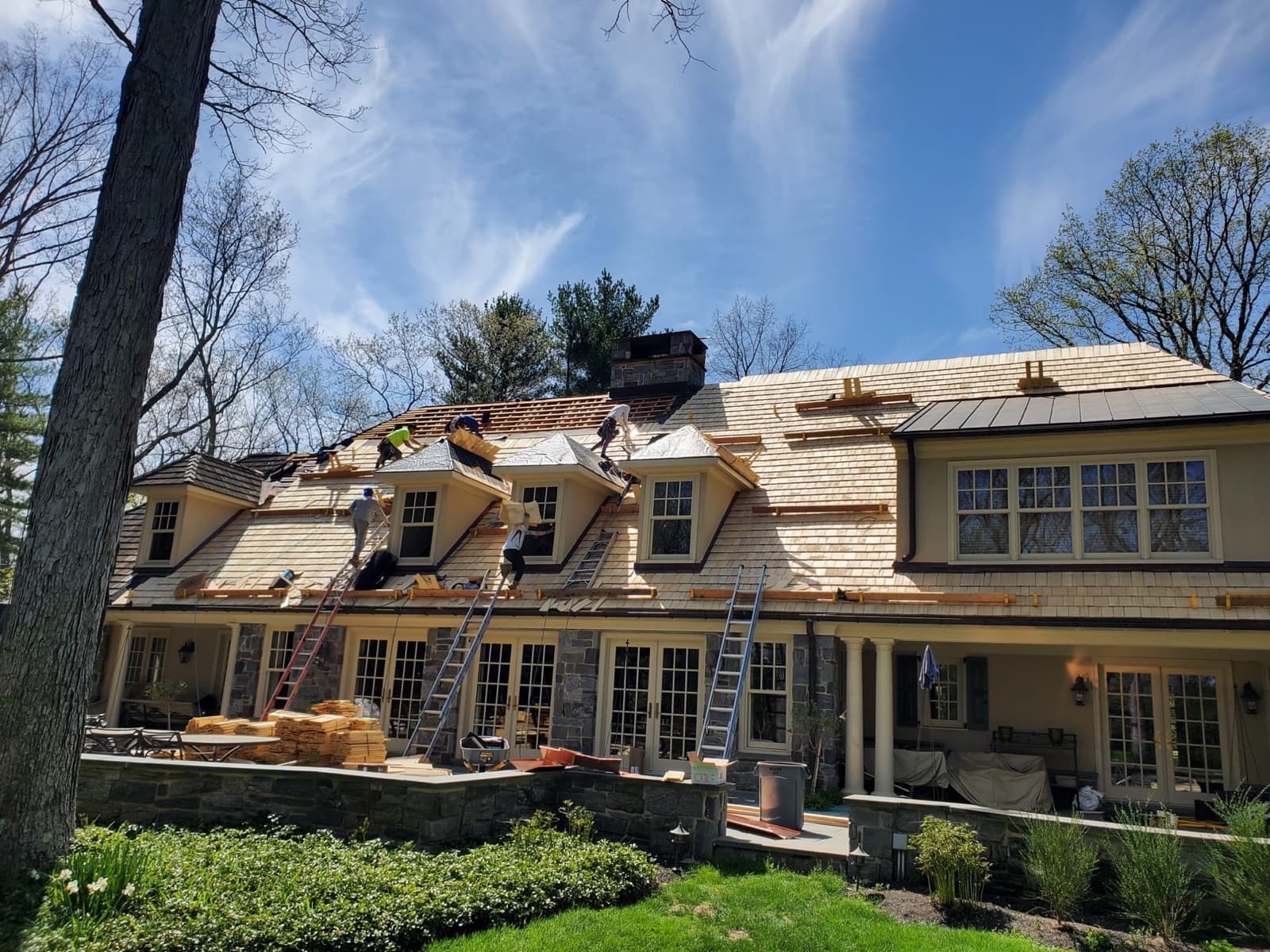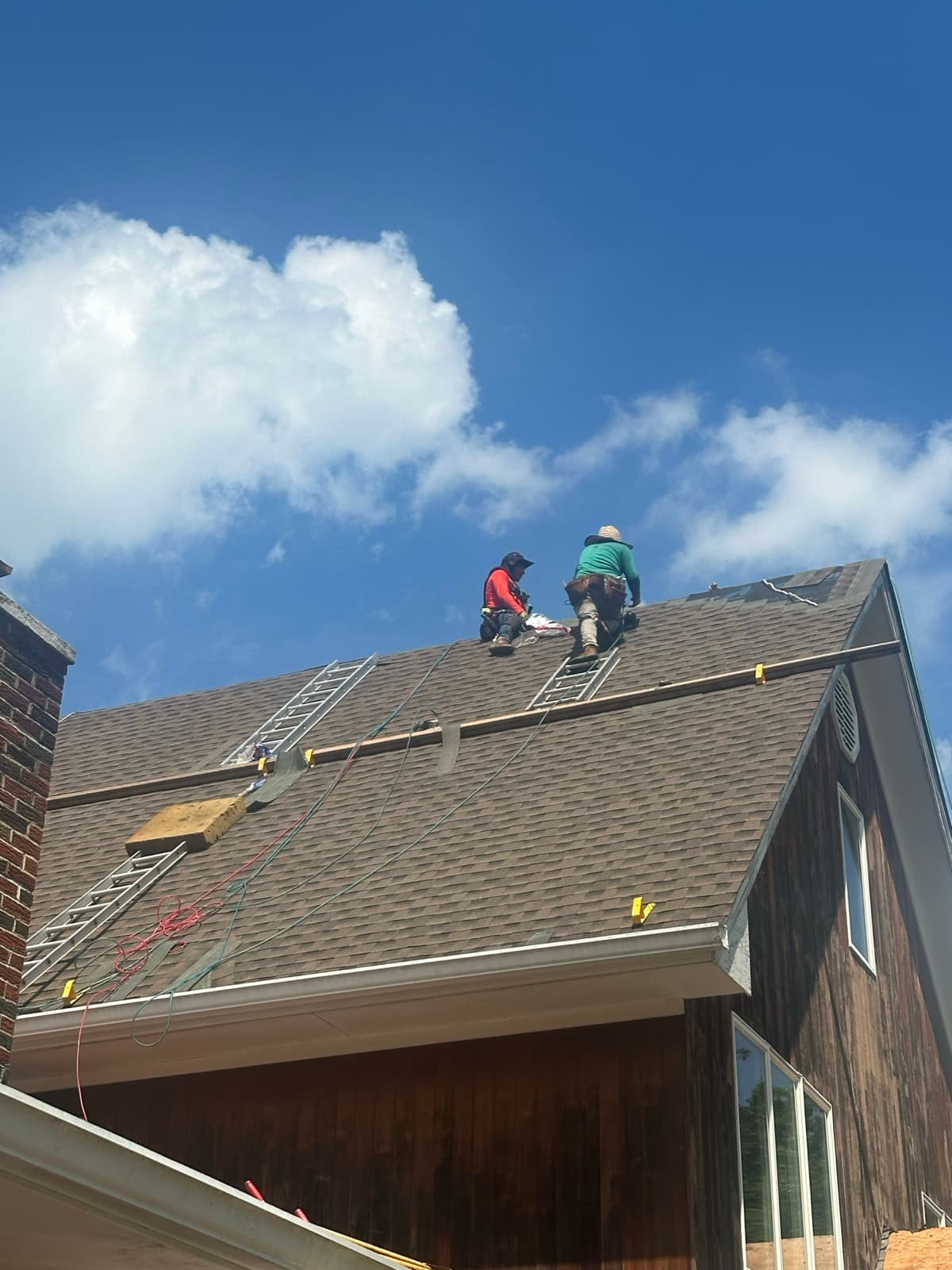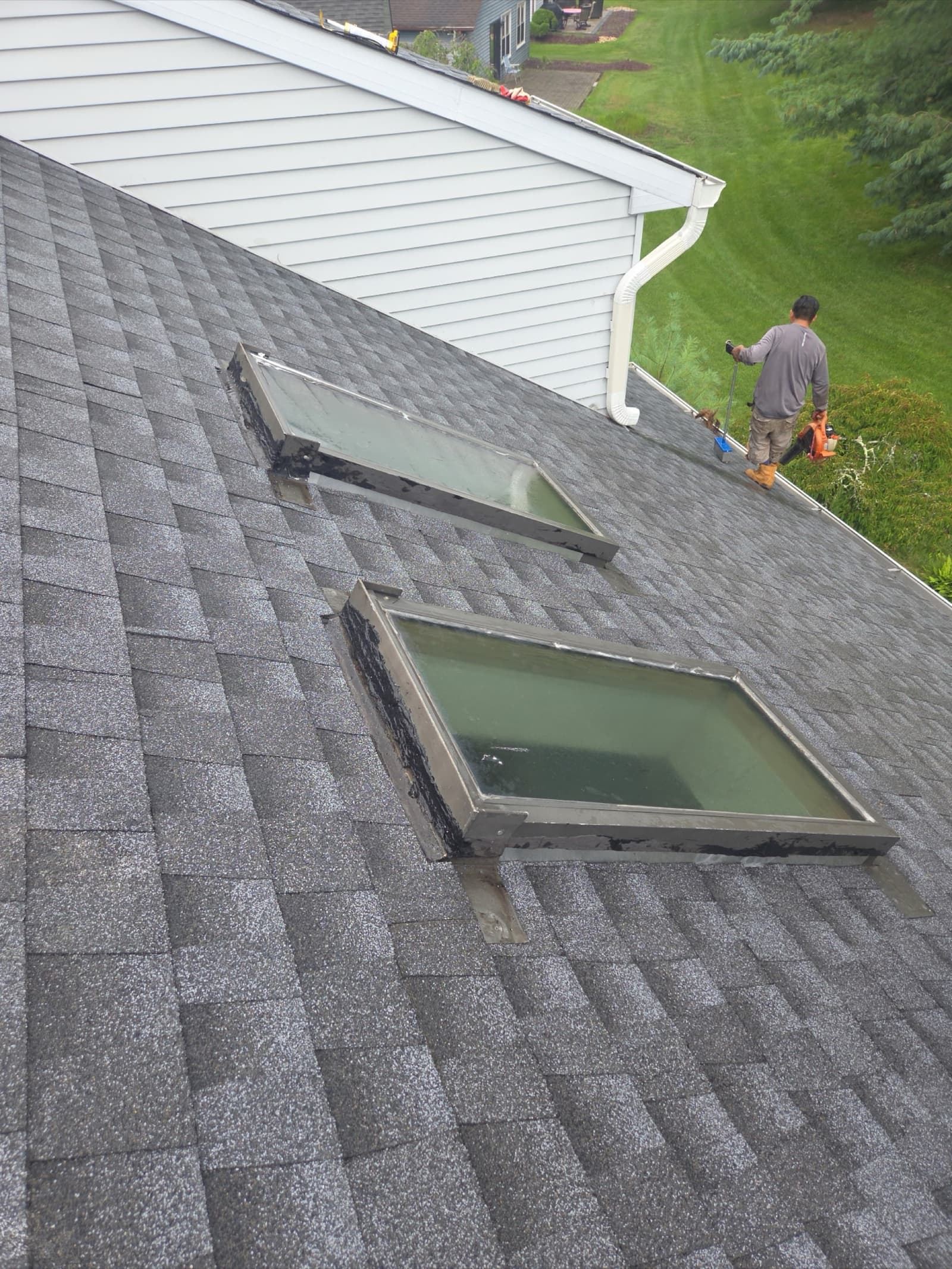
Mountain Lakes is unlike anywhere else we work. Most of the borough was built between about 1910 and the early 1920s by a single developer, Herbert J. Hapgood, and then by the Belhall Company that followed him — stucco Craftsman houses with boulderstone chimneys, deep wrapping porches, and structural beams deliberately left exposed under the eaves. Because so much of it came from one detail set, the roofs here repeat in a way they do not in an ordinary suburb. The Borough has gone further than most and published a handbook describing what those roofs originally were and how they are put together. We read it before we quote, and we inspect and photograph the roof before we price it.
Housing in Mountain Lakes
The borough has roughly 1,400 households and the great majority of its homes are owner-occupied detached houses, with about two in five predating 1940. The Borough maintains a list of contributing dwellings to its historic district, and as of its 2019 update that list identified 417 Hapgood houses, 61 Belhalls and 26 others — 504 contributing dwellings in total. Those are contributing-dwelling counts on a Borough list rather than a census of every house, but they give a fair picture: this is a town where the same builder's details recur street after street. Practically, that means the same roof problems recur too. When we find how a particular eave, dormer or chimney junction was originally built, that knowledge usually transfers to the next house.
What we most commonly find on Mountain Lakes roofs
- Deteriorated roofing at the eave line above exposed Craftsman beams, where a careless tear-off can damage the beams themselves
- Dormer cheek and sidewall flashing on the many dormer forms the Borough's own handbook catalogues, frequently sealed rather than properly flashed
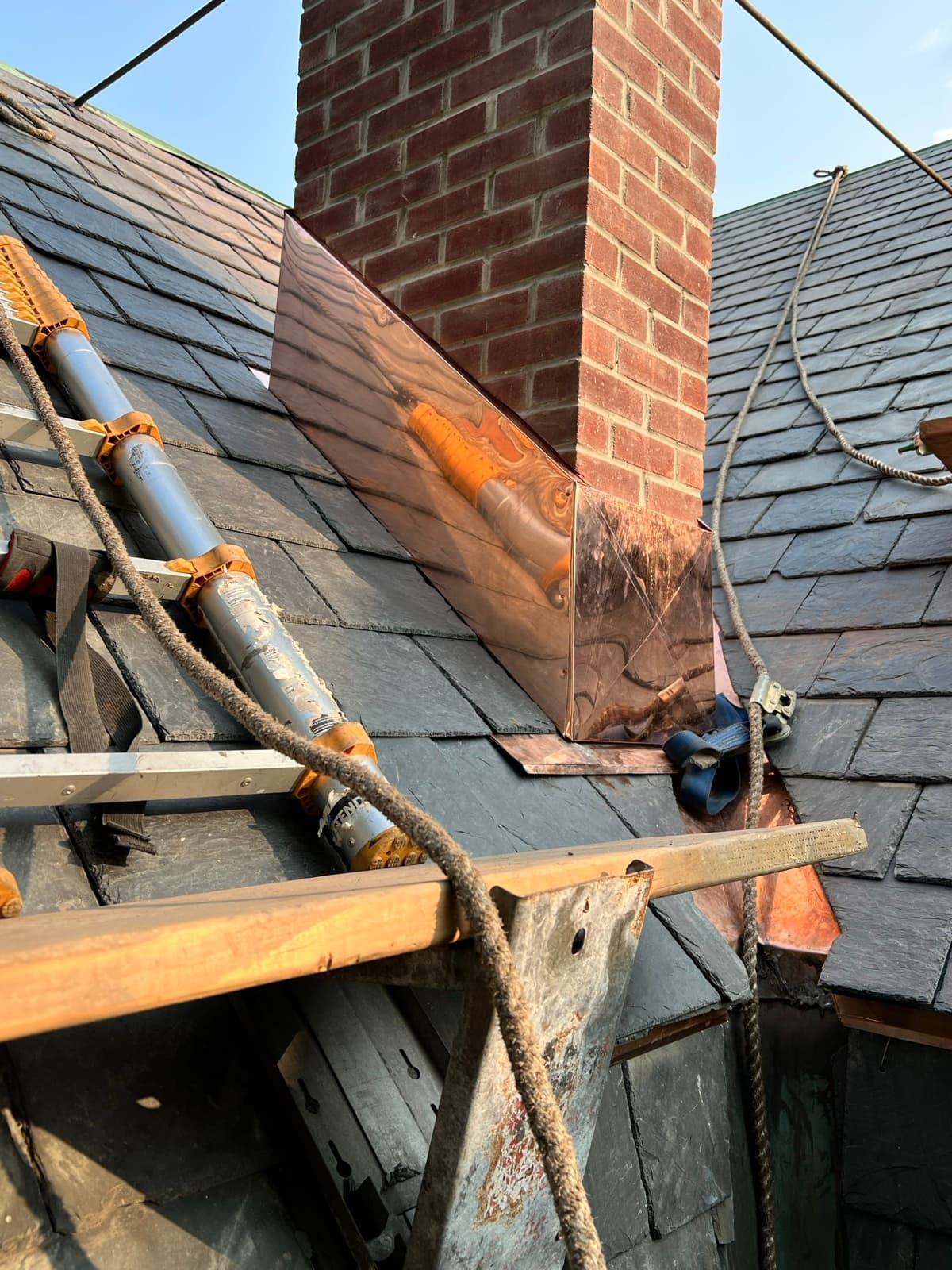
- Flashing into boulderstone and rubble-stone chimneys, where the irregular surface makes a reglet-and-counterflashing detail genuinely difficult
- Porch and porte-cochère roofs over enclosed or occupied space, which behave as conditioned-space roofs and need different ventilation and insulation treatment
- Short, awkward valleys where the borough's cross-gabled and clipped-gable forms meet, carrying concentrated water
- Stucco-to-roof junctions where the wall material will not tolerate the same flashing approach as clapboard or shingle siding
What the Borough's own handbook says about these roofs
In 1996 the Mountain Lakes Historic Preservation Committee, appointed by the Borough Council, produced the Historic Mountain Lakes Restoration and Renovation Handbook. It is still linked from the Borough's own site. Under its heading on roofs it says: the original roofing materials were mainly cedar shakes, although slate was occasionally used; and that when entirely re-roofing, new materials can be used instead of the formerly used materials, but the new materials should be compatible substitute materials.
Two things follow from that, and they pull in opposite directions, which is why it is worth stating both. The first is that these were cedar-shake roofs to begin with, and a house designed around a shake roof has eave, dormer and valley details that were drawn for shakes. The second is that the handbook itself contemplates substitution — it does not say you must put cedar back. It is guidance about compatibility, not a rule, and it dates from 1996.
The handbook also says something a roofer should take seriously about the eaves. It states that the functional and decorative features of the roof — eaves, cornices, chimneys, dormers and flashing — should be preserved, and that in Mountain Lakes, where it is important to preserve Craftsman features, exposed beams under the eaves should not be covered over. On these houses the beam ends under the eave are a defining architectural element and they are also physically vulnerable during a tear-off. Protecting them is a sequencing and staging decision made before the first shingle comes off, not something that can be fixed afterwards.
One honest caveat, because it matters: the handbook describes what these roofs originally were. It is not a statement about what is up there now. A century on, plenty of Mountain Lakes roofs have been through one or more asphalt generations. What is actually on your roof is a question for the inspection.
Nine roof forms and fourteen dormers, already named for you
The handbook does something we have not seen another New Jersey municipality do: it catalogues the shapes. Its Figure 3 is titled Roof Styles of Mountain Lakes and names nine — gabled, cross-gabled, double-cross-gabled, clipped-gabled, hipped-square, hipped-rectangular, gambrel, gambrelesque and mansard. Its Figure 4, Dormers of Mountain Lakes, names fourteen: short-shed, long-shed, gabled, double-gabled, triple-gabled, clipped-gabled, hipped, gambrel, two eyelid variants, arched, double-arched, and two face dormers.
That is not trivia. Roof form determines where a roof fails. A clipped gable — a jerkinhead — puts a short hip at the ridge end and creates two extra junctions that a plain gable does not have. A gambrel has a break partway down the slope where the pitch changes sharply, and that break is a classic leak point because water arrives there fast and the detail is often the oldest thing on the roof. Cross-gabled and double-cross-gabled forms generate valleys that are short, steep and prone to holding debris. Eyelid and arched dormers cannot be flashed with straight step flashing at all; they need formed metalwork, and the usual failure we find on them is a bead of sealant where formed metal should be.
When we inspect a Mountain Lakes roof we identify the form and the dormer types first, because that tells us where to look hardest. It also gives us a shared vocabulary with you: if the Borough's own handbook calls the thing over your front bedroom an eyelid dormer, that is what we will call it in the estimate.
The historic district here does not tell you what to do with your roof
This surprises people, so it is worth being unambiguous. The majority of the borough was listed as a historic district on the State and National Registers in 2005. That is a listing, and listing is an honour and a planning designation — it is not design review over private property.
Mountain Lakes has a Historic Preservation Committee, and its role is advisory: it assists the Borough Council on preservation matters and advises the Planning Board and Zoning Board on development applications. There is no certificate-of-appropriateness process here and no mandatory design review for a reroof. The Borough answers the question directly in its own FAQ. Asked whether an owner of a historic home needs special permission to make alterations, the Borough's answer is no — you can make whatever alterations you like, subject to the existing construction and zoning ordinances — and it says the ordinance contains no mandates for homeowners.
There is a separate, voluntary incentives ordinance under which an owner of a contributing dwelling who wants zoning relief such as additional floor area can opt in, and one of its eligibility conditions involves preserving the height and roof shapes of the existing home. That is a condition attached to a bonus somebody chooses to pursue, not a roofing rule, and it does not apply to you unless you are seeking the incentive.
So the position is: strong published guidance, no regulatory approval step, and the decision is yours. On the construction-permit side there is nothing Mountain Lakes-specific either — the Borough publishes no roofing permit rule, and the applicable law is the statewide one, under which replacing the existing roof covering on a detached one- or two-family home is ordinary maintenance requiring no construction permit, while replacing sheathing or doing structural work does.
Why we work in Mountain Lakes
We took this page on deliberately, and we will be straight about why. Mountain Lakes is small — roughly 1,400 households — so it is never going to be a volume market for anyone. What makes it worth the work is that it is a genuinely distinctive roofing problem that the existing pages for this town do not engage with at all; several of them lead with commercial flat-roof copy on a town of stucco Craftsman houses. The Borough has published the vocabulary, the housing is consistent enough that expertise compounds from one house to the next, and the details that matter here — exposed beams, formed dormer metalwork, flashing into boulderstone — are exactly the kind of work that rewards care. We have no completed project in the borough to point to, and we are not going to pretend otherwise. What we can offer is an inspection by someone who has read the handbook.
Mountain Lakes sections we cover
Mountain Lakes estimates cover the whole municipality — the Hill Section, Midvale, The Village, Lake Arrowhead, and Fox Hill Lakes — across ZIP code (07046).