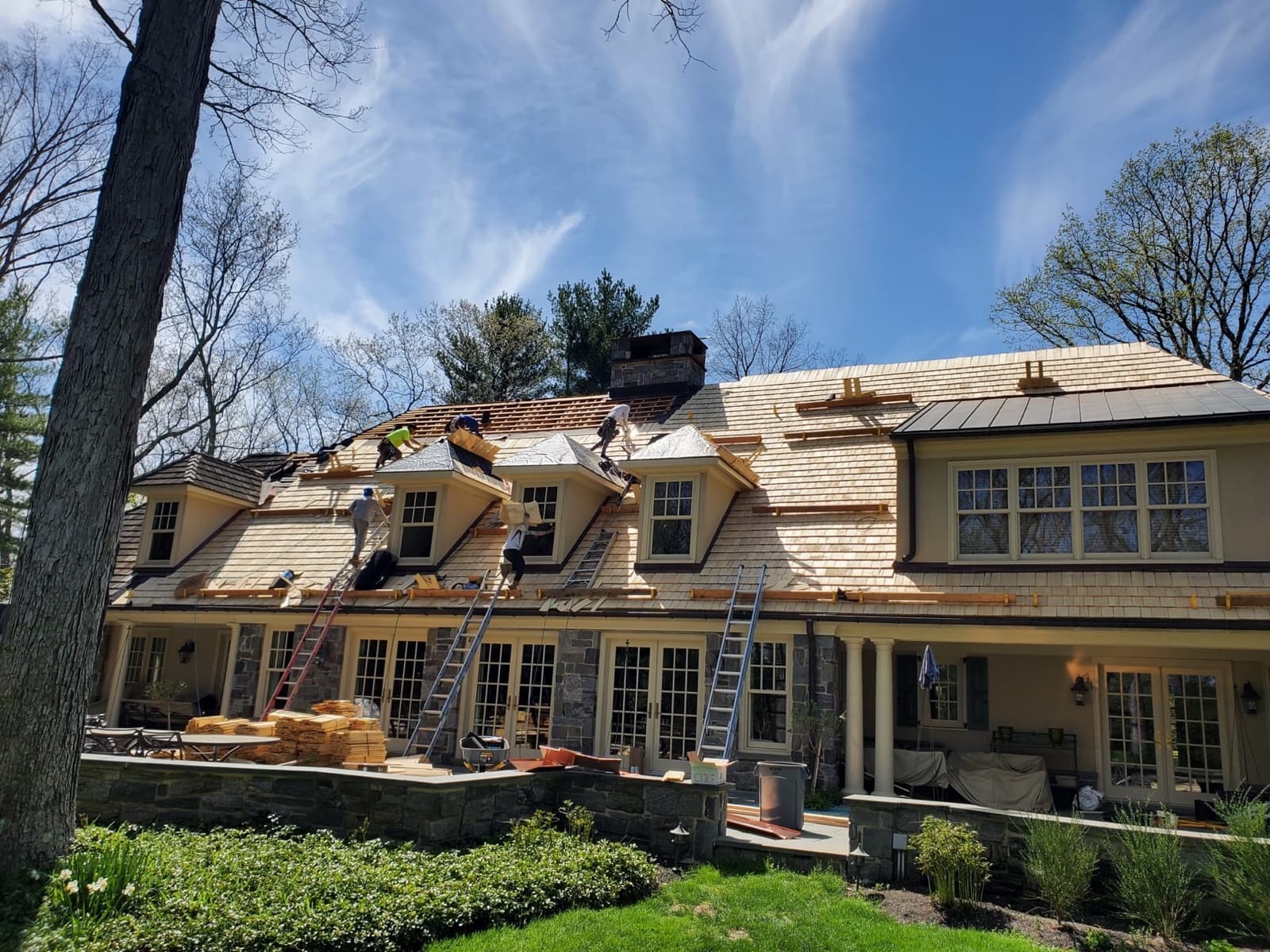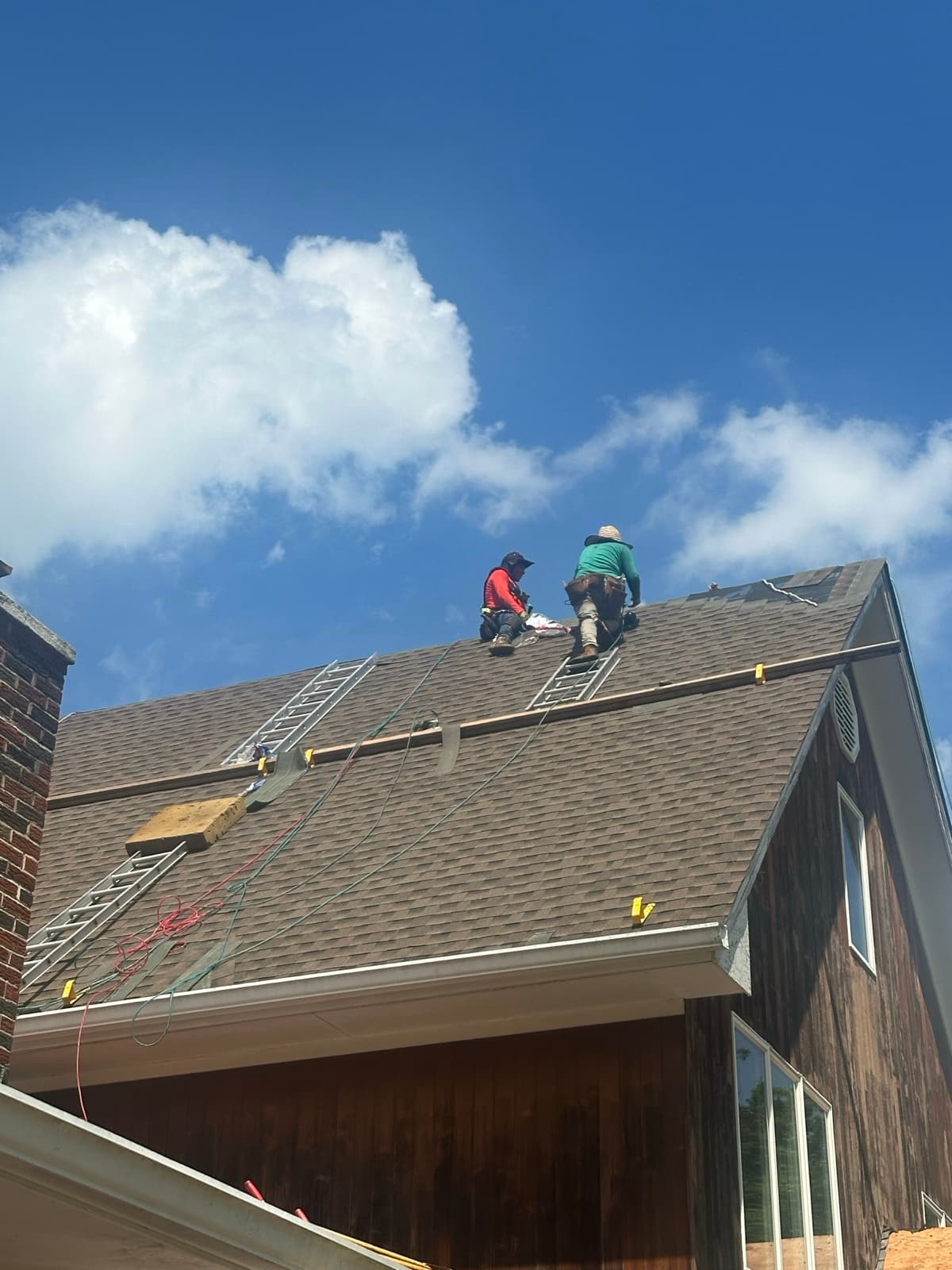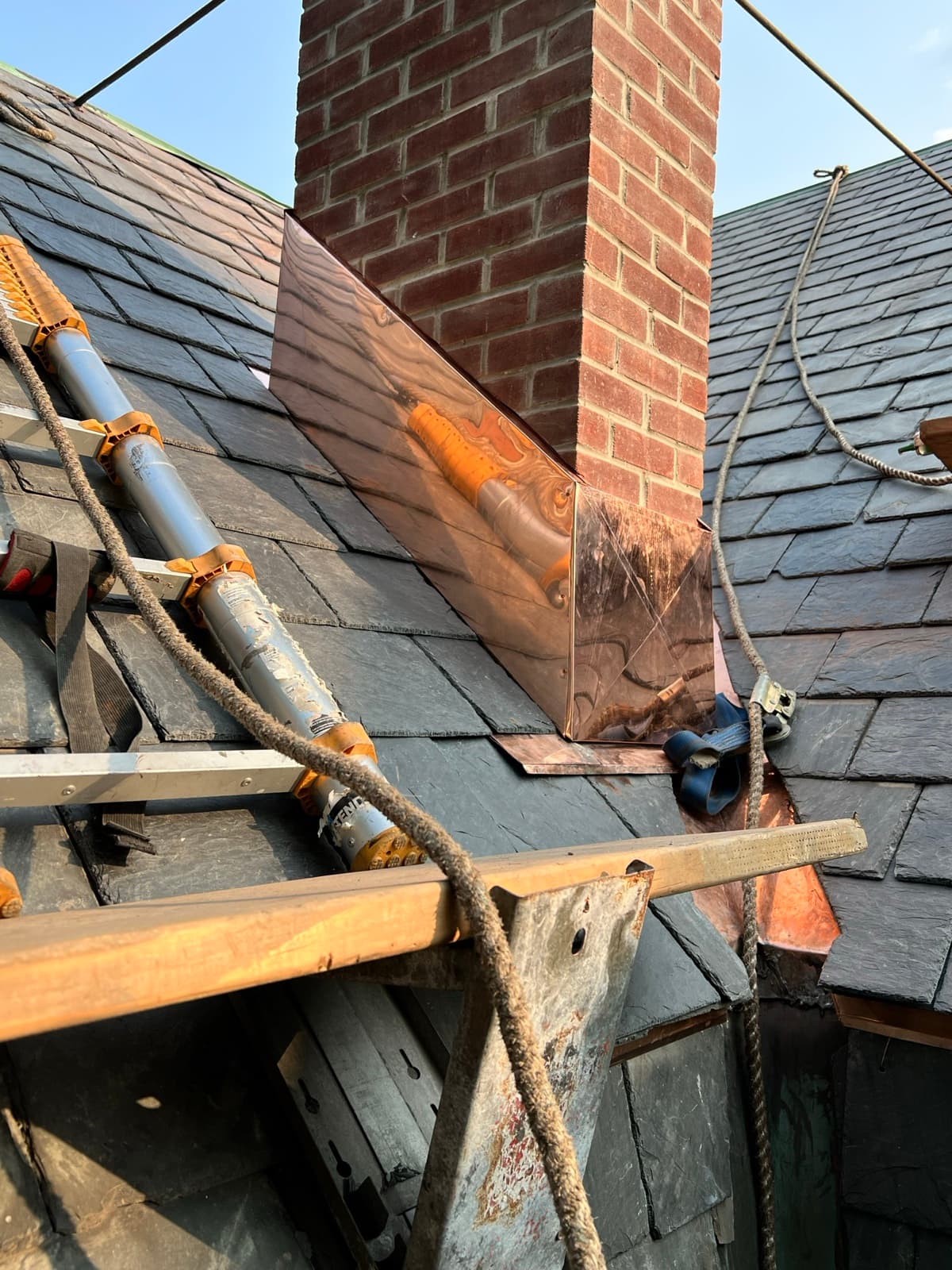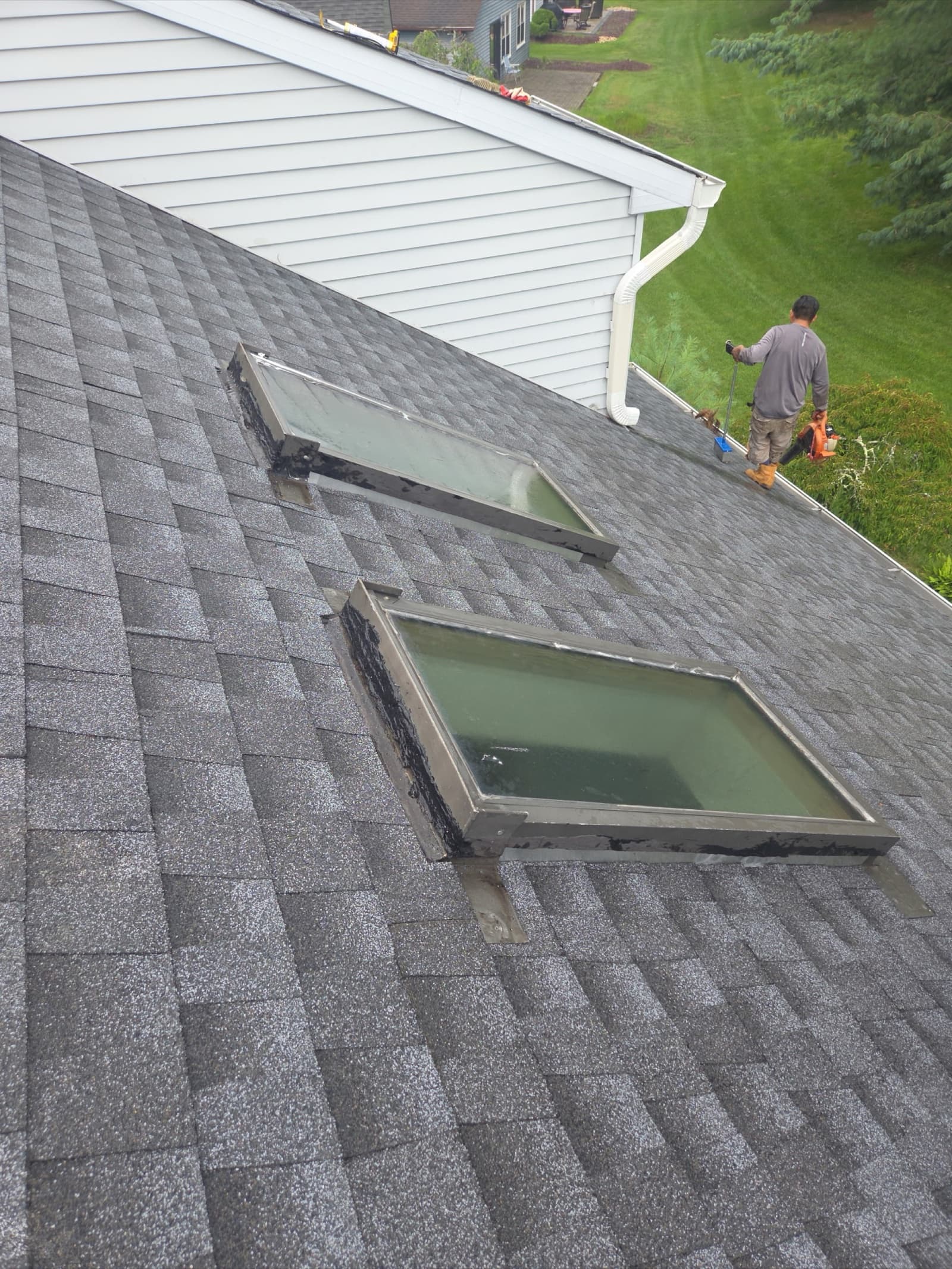
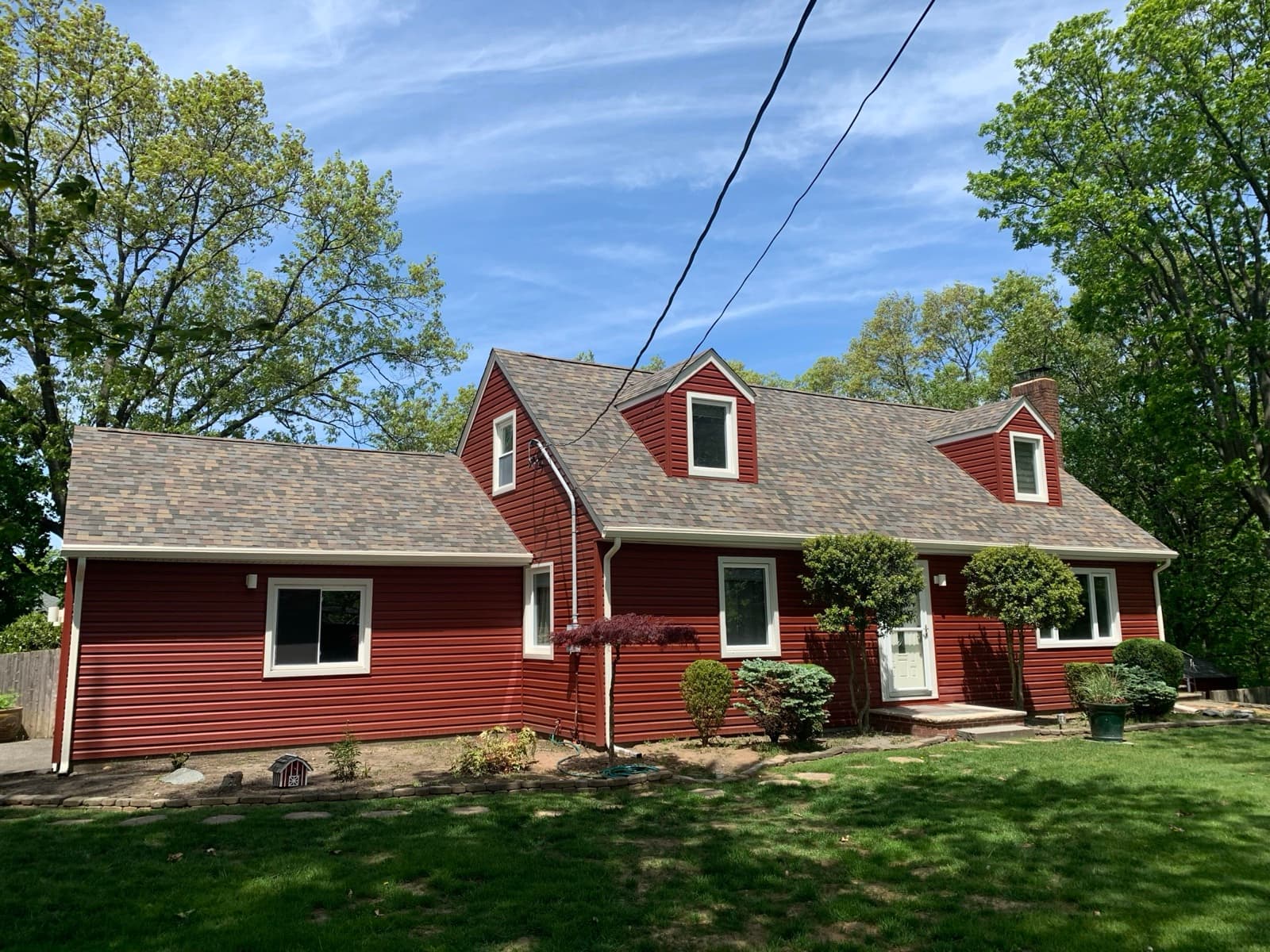
Maplewood is the oldest-housing town we work in by share: roughly 55 percent of its homes predate 1940, against about a quarter in most Essex County suburbs. The Historic Preservation Commission's own architectural surveys record roof form and roof material house by house, and what they describe is a town of side-gable, front-gable, hipped and gambrel roofs, with Queen Anne turrets and steep Tudor Revival pitches mixed in. Asphalt shingle is the primary covering, but the surveys also record a real population of slate and clay tile, particularly along the Prospect Street ridge.
Housing in Maplewood
The housing is stylistically mixed in a way that matters on a roof. Queen Anne houses bring conical turret roofs and several intersecting planes. Colonial Revivals bring gambrels, which carry a break in pitch partway down that has to be flashed rather than shingled through. Tudor Revivals bring very steep pitches, swept eave edges and chimneys that are a dominant part of the facade, which makes roof-to-chimney flashing the leading leak risk on that style. Foursquares bring four-plane hips with large dormers, so dormer cheek flashing becomes the detail that matters. Craftsman houses bring low pitches with wide overhangs and exposed rafter tails that are easy to damage during a careless tear-off. Several College Hill houses combine two of these on one roof. The practical consequence is that a Maplewood roof is rarely quoted accurately from a satellite measurement alone.
What we most commonly find on Maplewood roofs
- Roof-to-chimney flashing failure on Tudor Revival houses where the chimney is a large facade element
- Leaks at the pitch break on a gambrel roof, where the steep lower slope meets the shallow upper one
- Valley metal failure where intersecting gables on Queen Anne and Shingle Style houses produce many valleys per square
- Dormer cheek-to-roof flashing on Foursquare hips with large attic dormers
- Slate and clay tile sections patched with asphalt by a previous contractor rather than matched
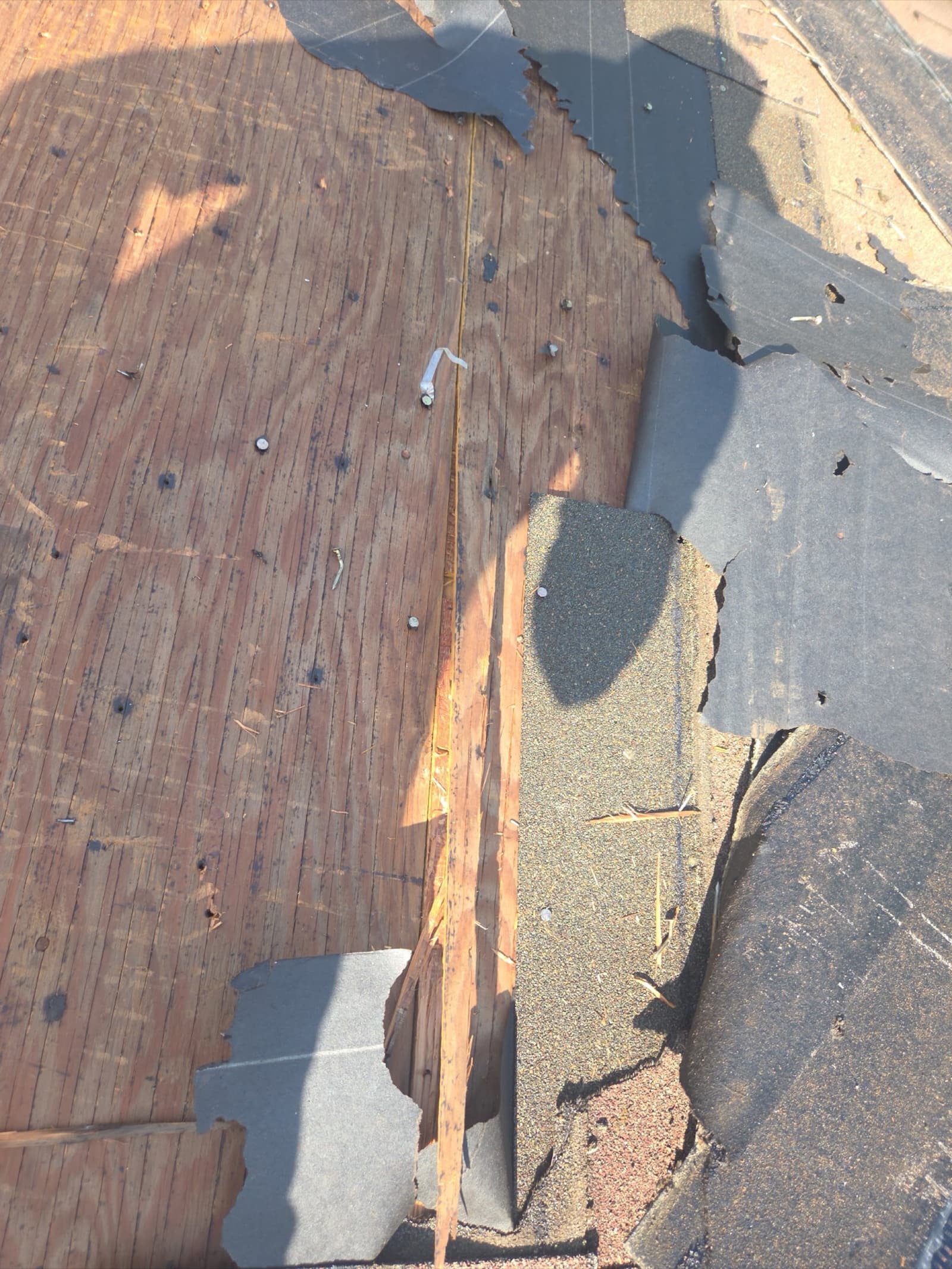
- Exposed Craftsman rafter tails damaged during tear-off when the crew is not briefed to protect them
Maplewood's own website gives two different permit answers
This is worth stating plainly because it sends homeowners in circles. One township page, under the heading of when you need a building permit, lists replacing a roof as the first item. A second township page, published by the Construction Division itself, lists the repair or replacement of existing roof covering on detached one- and two-family dwellings under work that does not require a construction permit.
The second page is the one that matches the controlling state rule. N.J.A.C. 5:23-2.7(c) states that the listed items are ordinary maintenance and shall be treated as such by every enforcing agency, and (c)1x is the roof-covering item. So for a detached one- or two-family house in Maplewood, a straightforward re-roof is ordinary maintenance: no construction permit, no inspections. The exemption still does not cover attached homes, work that alters rafters or a ridge beam, or buildings of three or more units, and it is not an exemption from the code itself.
Two practical notes. The enforcing agency is Maplewood's own Construction Division at Town Hall on Valley Street, not the county: Essex County's construction board is an appeals body and does not issue Maplewood roofing permits. And if storm damage forces emergency work, Maplewood's published path is that the work may begin before a permit, provided the Construction Official is notified and the application follows within 72 hours.
Being in the historic district restricts less than most people assume
Maplewood Village was listed on the National Register in 2022, and there are eight Historic Preservation Commission survey areas across the township. Homeowners regularly assume that means their roof needs approval. For the overwhelming majority of Maplewood houses it does not, and the Commission says so directly: listing on the State and National Registers does not place restrictions on private property owners' rights. Register listing supplies review against public and government projects, not against your roof.
Where it does apply is narrow and specific. Maplewood has twelve locally designated landmarks, and on those properties a change of materials does require Commission approval at a public hearing. Even there, the Commission states that maintenance and repairs of existing materials, and emergency repairs, do not have to come before it. So slate replaced with slate, and a storm repair, sit outside review even on a designated landmark.
The distinction that trips people up is the word district. The survey areas use that phrase in a survey and eligibility sense, not a regulatory one. Being inside one does not trigger roofing review. If your property is one of the twelve landmarks, we will tell you, and we will put the material specification in writing in the form the Commission asks for.
What a Maplewood tear-off has to account for at street level
Maplewood adopted an exterior-work ordinance in September 2024 that goes further than the neighbouring towns in this county. It requires a scaled construction plan for exterior work, allows the township to require a safety plan before a permit issues, and where work happens above eight feet and within five feet of a property line it requires a barrier and a covered walkway. It also requires a pedestrian walkway kept clear in front of the site, and it confines tear-off dumpsters inside the construction fence with a rule on how quickly they are emptied.
On the tight lots common in the Village and on College Hill, that changes the logistics of a roof job rather than the roofing itself. Separately, the township's tree ordinance requires a permit, certified-mail notice to abutting neighbours, and a township-registered tree company before a tree of twelve inches or more comes down. If a limb has to move before the roof does, it is not a same-week item. We would rather tell you that during the estimate than on the morning of the tear-off.
Why we work in Maplewood
Maplewood is the kind of roof we would rather be on. Pre-war houses with steep pitches, turrets, gambrels and real slate reward a contractor who can read the roof and match what is there, and they punish one who treats every job as a tear-off and a bundle count. The other reason is simpler: the permit and historic questions in this town have documented, checkable answers, and nobody was publishing them.
Maplewood sections we cover
Maplewood estimates cover the whole municipality — Maplewood Village, College Hill, Prospect Street, Ridgewood Road, Golf Island, Hilton, Valley Street, Jefferson, Tuscan, and Memorial Park area — across ZIP code (07040).